I can ask AI for three plans to replace a piece of software and have all three before my next call. Each can have sensible milestones and a credible account of what might go wrong. The hour I’d still want to spend is with someone who uses the software. Maybe they just need to see where the previous shift left off. If that’s the case, every one of my plans is an elaborate way to avoid fixing a small problem.
I use AI extensively in my work as a software consultant and entrepreneur. I like being able to get to a competent draft quickly. It’s also changing what impresses me when I look at someone else’s work. I want to know why they chose this problem, what they understood about the people who had it, and what they did once their idea met those people. A good plan used to tell me more about the person who handed it to me. I’m starting to look for that evidence further along in the work.
What a good answer is worth
There’s some evidence for the change at the level of individual tasks. In an experiment on short professional writing assignments, Shakked Noy and Whitney Zhang found that participants given access to ChatGPT took 40 percent less time on average and received higher quality ratings. Think of assignments like a short report or a press release. The experiment measured what people could produce on an assigned task. Choosing the task in the first place is a different piece of work. Experimental evidence on the productivity effects of generative artificial intelligence
In my essay on go-to-market judgment, I argued that cheaper automation makes it more important to stay close enough to a buyer to learn why they acted. The same problem comes up when I use AI to understand a technical decision. I can get a clear account of how a system is supposed to behave. Understanding it means being able to predict what will happen when one of our assumptions breaks. Choosing a worthwhile question means knowing which of those failures would actually matter. If I recommend a change, somebody should be able to come back to me when it behaves differently in production.
If competent reports, explanations, and arguments become easier to get, there will be more plausible things to read than I have time to evaluate. I’ll give more weight to the person who can put one relevant finding in front of me, explain how they know it holds, and tell me what they’re prepared to do about it. A rare point of view can still be useless. The value comes from helping me see or do something I would have missed, with enough reason to trust the judgment behind it.
I suspect this could change who earns standing in some circles. People may start asking whose lead they’d follow after the proposal is written, when there are real tradeoffs and somebody has to come back next week. That shift depends on what people get to see. A team that can watch someone catch a bad assumption and help revise a project has more to go on when it chooses its next lead. In a field where a proof or a design is itself the hard-won result, producing it may still tell us a great deal about someone’s ability. Expertise matters at every point where the difference between a plausible answer and a sound one has consequences.
What analog warmth feels like
A letter can make me feel that someone thought about me specifically. It might contain a detail I’d forgotten telling them. I can picture them sitting with the page for a while, deciding how to say it. I call this analog warmth. It’s what I feel when another person’s attention takes a form I can experience. A long conversation makes time for it. A carefully built object can carry it through the choices someone made about how it would be used.
At ProfileScribe, my work has increasingly moved toward personalized physical mail, including comics and unusual printed formats. I’ve been working through the printing, paper, cutting, folding, and assembly. A fold can determine whether a reader sees a setup before the joke. Even paper choice can change how readily the piece opens in someone’s hands. Those details are part of telling the story. The reward I’m interested in is the moment a recipient recognizes why someone chose that story for them.
A glossy mailer can put my name in three places and give me very little reason to believe anybody considered me. A friend who sends a voice note after an appointment I mentioned last week can convey a great deal in forty seconds. Personalization can start with a name. Attention shows up in which detail someone noticed, why it mattered, and what they made of it. Paper gives that attention a few more ways to be felt. A phone gives it others.
What I mean by a Vitalist
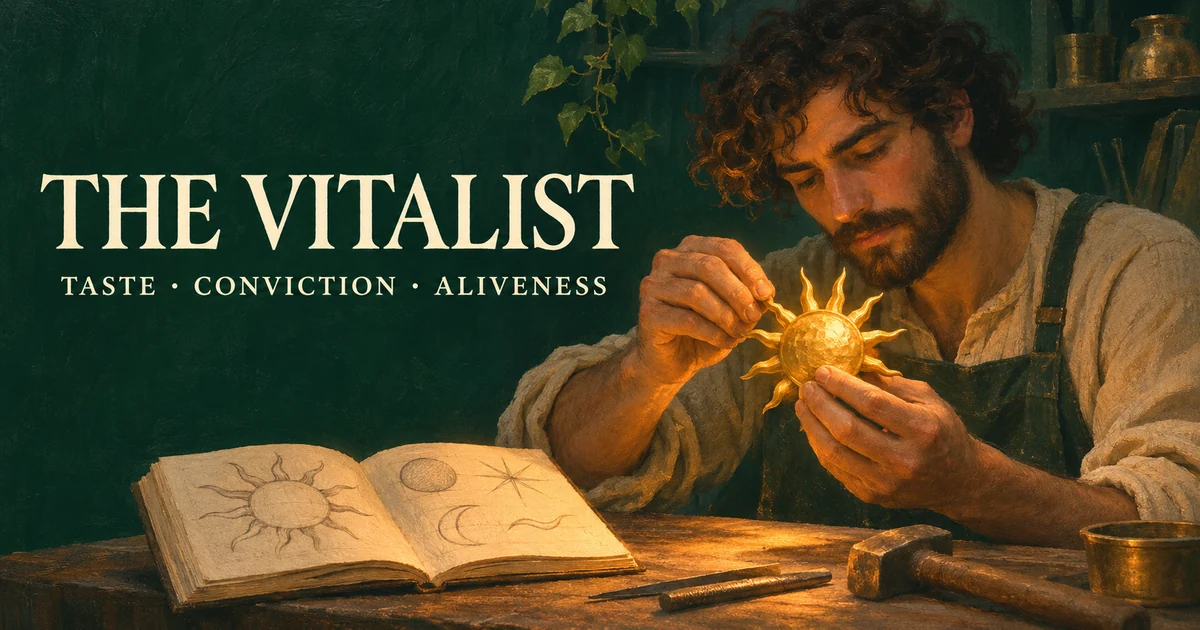
I call someone a Vitalist when their taste, lived conviction, and attention give ideas a meaningful form in the world. I mean it as a cultural archetype. The Vitalist decides what deserves to exist, commits to making it real, and cares about what happens when other people encounter it.
Taste is the ability to choose what belongs and make the parts work together. Imagine designing a tool that helps people find a place to study. You could add a dozen search filters, or you could spend a day watching someone try to find a room. If they keep getting up to ask whether the room is actually available, the most important line on the screen might be the one that tells them when they can walk in. Taste develops when you let the way the work lands change what you thought mattered.
Conviction is what you’re willing to keep choosing once the choice costs you something. A founder who promises that people can take their data with them shows conviction by keeping exports working even when another feature would make for a better demo. If the export turns out to be useless to people trying to switch, the promise gives the founder a reason to revise it. A commitment can survive a change in how you carry it out.
Creation gives other people something to encounter. It could be a tool, a letter, or an institution. A person who starts a neighborhood repair night has made something people can return to. Finding a room, getting a few people to bring tools, and making it easy to ask a beginner’s question are all part of the creation. Keeping the door open the following month might be the most consequential thing they do.
That’s the kind of aliveness I have in mind. It’s the engaged participation of someone who wants to see what an idea can become and stays involved as it takes shape. A quiet afternoon spent getting a tool right for the person who needs it can be full of that quality.
More than a host
A Host creates a room people want to inhabit. A Convener brings together people who have a reason to meet. A Steward keeps the trust and continuity that let them come back. I see all three as expressions of the Vitalist. A good host’s warmth might be visible across a room. The same care can be felt in a chair a quiet maker built for an awkward corner, a tool a technically minded founder made forgiving of mistakes, or a half hour an attentive friend sets aside each week. Much of the work I admire would be easy to miss if I only looked for the person everyone wanted to talk to.
Who stands behind the work?
AI complicates this idea in a way I take seriously. It can help make beautiful work, write a line that moves somebody, and produce choices I’d be proud to have made. In an experiment by Anil Doshi and Oliver Hauser, readers rated short stories more enjoyable when their writers had access to AI-generated story ideas. I can grant that a machine’s contribution might be the very thing that makes a piece worth keeping. Generative AI enhances individual creativity but reduces the collective diversity of novel content
The question I care about is what someone is prepared to stand behind. Imagine a founder uses AI to write a thoughtful response to a customer whose work disappeared. The note can bring real relief. The same system might even help recover the work. The founder decides what the company promises, who checks whether the recovery succeeded, and what the company does if the work is gone. Part of the value of the original response lies in what the customer can count on afterward.
I might use AI at every stage of making a comic. I can ask it which panel to cut and take its advice if it sees something I missed. If I can generate twenty layouts in the time I once spent on one, I can spend some of that time printing a proof, slipping it into an envelope, and opening it the way the recipient would. If the detail that makes the comic theirs disappears into the crease, I can move it into view just as the page opens.