GTM Engineering may disappear because it won.
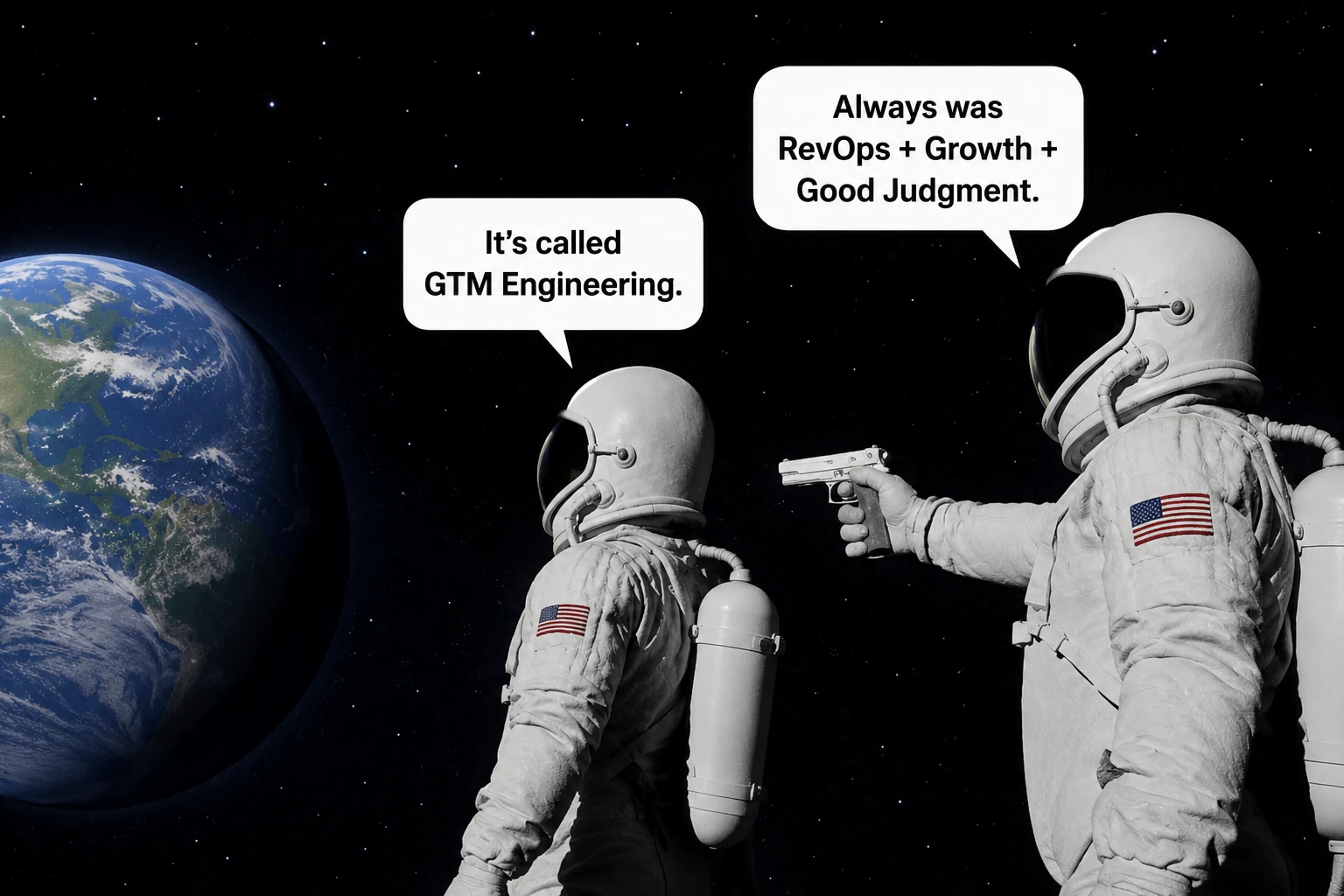
The meme gets the overlap right. It leaves out the customer.
The astronaut meme captures the argument in one frame. The joke is directionally right. RevOps operates the commercial system. Growth creates and captures demand. Judgment determines what is worth building.
But the meme is incomplete. Full-cycle go-to-market also touches discovery, positioning, objections, closing, retention, and customer feedback. The loop does not end when a lead reaches the CRM. It closes when the company learns why a customer bought, stayed, expanded, or left.
That is why I do not think GTM Engineering is dying. I think it is being absorbed into the job.
Why the role appeared.
Revenue teams accumulated enough machinery to need someone who could work across the seams.
The CRM was joined by enrichment vendors, sequencing tools, product analytics, intent data, call recordings, ad platforms, data warehouses, support systems, and whatever spreadsheet had quietly become production infrastructure. The scale of that accumulation is visible in Chiefmartec’s long-running map, which expanded from roughly 150 products in 2011 to more than 15,000.
The problem was not a lack of software. It was that the software did not share context, timing, or ownership.
Someone had to connect the signals, move the data, encode the rules, and make the commercial stack behave like a system. That person was often hiding inside RevOps, Growth, sales operations, or a founder’s browser tabs.
Clay helped popularize a useful name for the hybrid. Its current description of GTM Engineering spans automated revenue systems across RevOps, Growth, customer success, and consultative selling. The title gave technical commercial operators a clearer identity and companies a better hiring target.
It described a real constraint: there were more possible revenue workflows than people capable of building them.
The build is getting cheaper.
That constraint is moving.
Long workflows can now be assembled with much less code. Tools, APIs, agents, and MCP systems can be connected faster. Enrichment, cleaning, routing, and synchronization are increasingly available as configurable steps. Personalized outbound can be generated from structured research. Basic automations can be drafted and repaired conversationally.
This is already visible in products, not just predictions. Zapier’s Copilot lets a user describe a workflow in ordinary language. MCP provides an open standard for connecting AI systems to tools and data.
None of this makes technical skill irrelevant. It changes its scarcity.
The marginal cost of producing a first version is falling quickly. “Free” does not mean authentication, deliverability, rate limits, schema drift, permissions, data governance, monitoring, and compliance have stopped existing. Production systems still need owners. Complex companies will still pay for people who can make them reliable.
But assembling a plausible workflow is becoming baseline literacy inside Growth, RevOps, and founder-led sales. Soon, showing a long automation canvas may say little more than showing a well-formatted spreadsheet. Useful, certainly. Differentiating, less so.
AI also makes it easier to build the wrong thing with impressive efficiency. A beautifully enriched list of people who do not care is still a bad list. More affordable spam is not a strategy.
Judgment is still expensive.
The scarce question is no longer simply, “Can we build this?”
It is, “Should this exist?”
Should the company invest in inbound, outbound, partnerships, or a product-led motion? Which signals indicate buying intent rather than corporate weather? Which customer pain is urgent enough to close a deal? What does the buyer’s day actually look like? When will automation feel helpful, and when will it feel like surveillance with merge fields?
Those are questions of commercial judgment. You can also call it taste, as long as taste does not become a mystical substitute for evidence.
Commercial taste is compressed learning from customer exposure, repeated decisions, and consequences. It develops by hearing how buyers describe a problem before they adopt your language. It sharpens through objections, lost deals, stalled evaluations, onboarding friction, renewal conversations, and churn. It requires noticing the gap between what generated a reply and what generated revenue.
The hard part of a signal is not collecting it. It is deciding whether anyone should act on it.
This is where the astronaut meme stops short. RevOps can keep the commercial system coherent. Growth can create and capture demand. Judgment can point both at a worthwhile problem. But the full cycle still needs contact with the buyer. It has to connect positioning to pipeline, pipeline to sales conversations, and sales conversations to retention.
Automation does not replace judgment. It compounds it. Good judgment gets scaled. Bad judgment gets a sending schedule.
The role changes shape.
What follows is a prediction, not a description of a settled market.
At early-stage companies, I expect the role to become the Full-Cycle GTM Operator: part seller, part Growth operator, part RevOps builder, and part strategist. This person can understand the buyer, select the commercial problem, design the motion, build enough of the system, join the sales conversation, and revise the approach based on what closes.
At scaleups, I expect the standalone title to dissolve into embedded capability across Growth and RevOps. Workflow construction will remain valuable, but more operators will be expected to work with APIs, agents, enrichment, orchestration, and data without handing every request to a specialist.
At large companies, the technical specialty will survive. Enterprise stacks have real complexity, security, governance, and uptime requirements. The role may become Revenue Systems, GTM Platform, or Commercial Systems Engineering: narrower in commercial scope, deeper in architecture and reliability.
Company stage will not determine this perfectly. Sales complexity, regulation, data maturity, and business model matter. But the general direction is visible: routine construction spreads outward; specialized systems work moves deeper.
Full-cycle does not mean one heroic person performs every revenue function alone. It means someone is accountable to the whole learning loop and has access to the raw evidence. Buyer contact is the checksum for a GTM system.
GTM engineering becomes literacy. GTM operation remains a profession.
The name follows the scope.
For now, GTM Operator is the useful title. It signals responsibility for taking something to market, not merely maintaining the tools around that effort. It is broad enough to include selling, Growth, systems, and strategy without pretending those disciplines are identical.
Commercial Operator may be the eventual destination. That title makes more sense when the scope expands beyond acquisition into pricing, partnerships, contracts, expansion, retention, and revenue economics.
The difference is not cosmetic. A GTM Operator owns the motion. A Commercial Operator may own more of the economic system around it.
Titles will remain messy because companies are messy. The better test is not what the person is called. It is which decisions they can make, which customer evidence they can see, and whether they are responsible for the result.
Hire the whole loop.
Companies should stop treating an impressive workflow as sufficient evidence of go-to-market ability.
Ask candidates which commercial problem they chose and why. Ask what they decided not to automate. Ask how they distinguished intent from noise, what they learned from sales conversations, and what changed after the first version met a real buyer.
Look for the operator who can identify the problem, design the motion, build the system, observe the result, talk to the customer, and revise the original judgment. That loop is the durable profession.
The discipline of GTM Engineering is succeeding. Its tools are spreading. Its methods are becoming normal. The best practitioners are not being pushed out; they are being pulled closer to the commercial decision.
The workflow is becoming free. Knowing which workflow deserves to exist is not.