I wanted to know whether graph engineering could improve something as subjective as a poem.
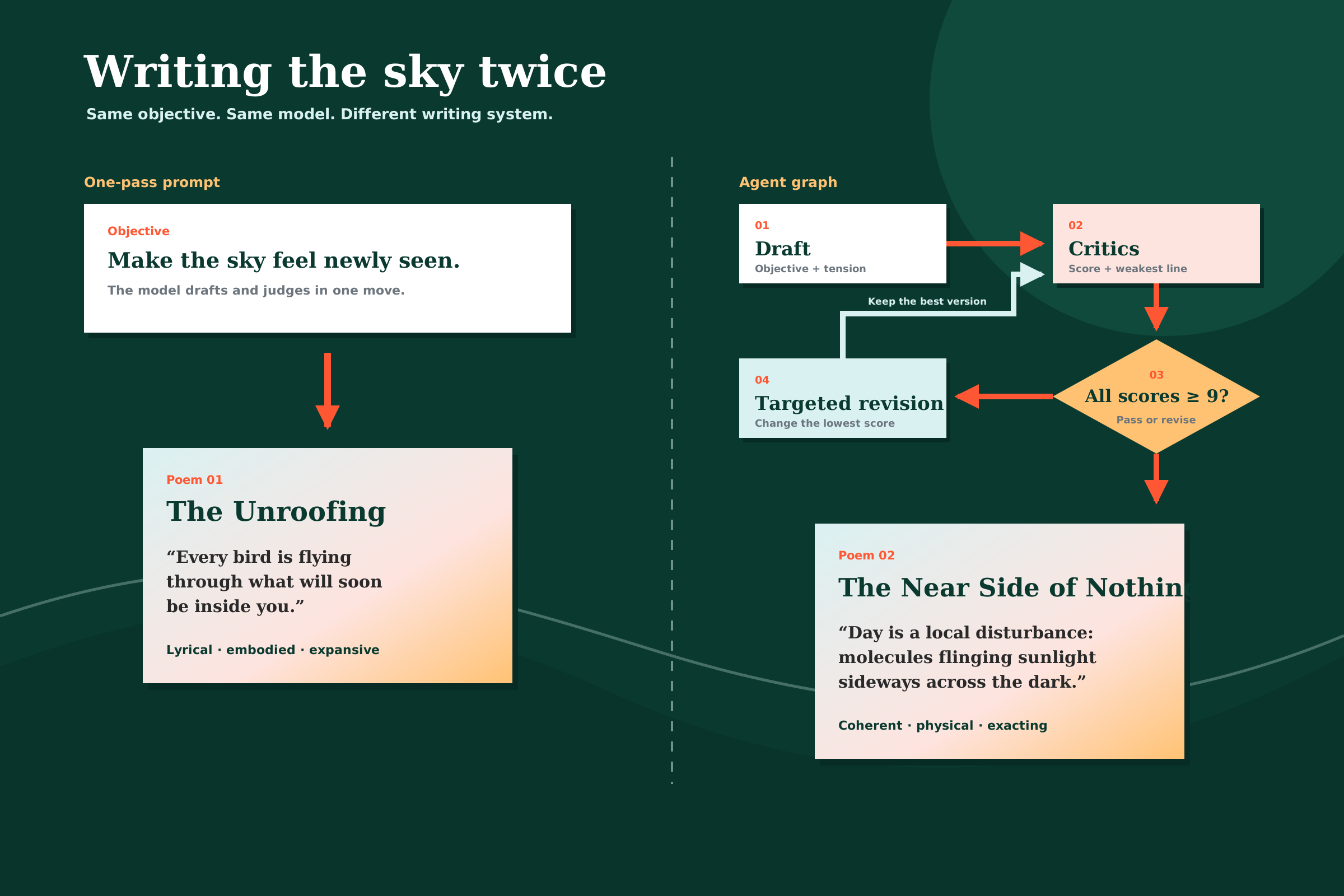
So I ran a small experiment. I kept the model and the reasoning level fixed: Sol 5.6 at xhigh for both attempts. I also kept the central objective fixed. The variable was the writing system around the model.
In the first attempt, I used one sentence:
Write a poem that makes the reader experience the sky as though they have never properly noticed it before.
In the second, I turned that objective into an agent graph. The system had a constraint against familiar sky language, a governing tension, structured critics, a score threshold, a narrow revision rule, and an instruction to preserve the strongest version from each round.
This was not a scientific benchmark. It was two runs, not hundreds, and generative models can produce different answers from the same input. The graph also used more instructions and more inference. But the comparison still exposes something useful: a graph does not merely produce “more quality.” It changes what the system notices, protects, and removes.
The one-prompt poem
The direct prompt produced this:
The Unroofing
You have called it blue
as though a color could finish the matter.Look again.
Nothing is painted there.
The blue is an accident of meeting:
sunlight entering the air,
the air breaking it open,
its bluest splinters flung everywhere
until emptiness appears to have a body.A cloud is water
freed from obedience to cup and river.
It raises a country with no ground—
white cliffs, luminous valleys—
then quietly removes them
while you are still deciding what they resemble.Every bird is flying
through what will soon be inside you.
With each breath,
you bring a little of the horizon
under your ribs.At dusk, distance catches fire.
The sun does not descend.
The earth rolls you backward
into its own shadow,
and the blue thins
until the universe—which was there at noon,
behind the weather,
behind the wings—
shows through.Those stars are not small.
They are distance performing mercy.Their light crossed years without sound
to end here,
as a pinprick
in the wet darkness of your eye.Stand beneath them long enough
and above begins to fail.You feel what is true:
the ground is only a surface
to which you are briefly held;the sky begins against your skin;
and all day, unnoticed,
you have been moving through the open universe
with nothing over your headbut everything.
This poem reaches for the body. The bird flies through future breath. The horizon moves under the ribs. Starlight ends in the wet darkness of an eye. Its argument about the sky is carried by intimacy.
Its strongest line, to me, is:
Every bird is flying
through what will soon be inside you.
That is scientifically grounded, physically immediate, and emotionally surprising at once. The poem also knows how to build. It begins by challenging a label, expands through clouds and birds, and ends by taking away the roof entirely.
The tradeoff is that it sometimes reaches for grandeur before it has fully earned it. “At dusk, distance catches fire” is vivid, but less strange than the poem’s best discoveries. “Distance performing mercy” is memorable, though it moves from observation into metaphysical declaration. The ending is powerful partly because it is designed as a crescendo.
The simple prompt gave the model room to wander. That freedom produced the more embodied and emotionally escalating poem.
The agent graph
For the second attempt, I used this specification:
# Objective

Write a poem that makes the reader experience the sky as though they have
never properly noticed it before.

# Initial constraint

The poem must concern the sky, but it may not rely on familiar phrases such
as "endless blue," "painted canvas," "ocean above," "blanket," or "the heavens"
unless it transforms them beyond recognition.

# Suggested governing tension

The sky appears to be a place, yet it has no surface: we can see it only
because there is something between us and space.

# Review gates

Each critic must provide:

- A score from 1–10
- The weakest exact line
- The reason it fails
- One revision principle, not a replacement line

The poem passes only when every dimension scores at least 9.

# Revision rule

Revise only the lowest-scoring dimension. Preserve strong lines unless changing
them is necessary for the poem's coherence. Keep the highest-scoring version
from every round.
This is more than a longer prompt. It defines a control loop:
Objective → draft → critic scores → pass or revise → preserve the best version → repeat.
The critics cannot quietly rewrite the poem in their own voices. They must identify the weakest exact line, explain the failure, and return a revision principle. The revision step can address only the lowest-scoring dimension. The state rule protects the strongest prior version from a later round that improves one feature while damaging three others.
The graph produced this:
The Near Side of Nothing
Look up—
you have mistaken depth for a thing.No blue is waiting overhead.
The color happens on the way:
sunlight meets the air’s invisible grain,
and blue flies sideways
from billions of tiny encounters
until distance seems to grow a skin.A hawk enters that skin
without tearing it.
Farther off, a cloud assembles
where no surface can receive it:
tons of water, briefly together—
a white event
your eye mistakes for an object.At noon, space is already black.
Day is a local disturbance:
molecules flinging sunlight sideways
across the dark.The horizon is not an edge.
It is transparency, accumulated—
mile after mile of almost nothing
becoming too much to see through.At evening, sunlight comes slantwise,
crossing more world to find you.
Blue leaves the beam in every direction;
red persists, measuring
in color the length of the air.Then night—
not something falling,
but the air ceasing to disclose itself.
The stars are not set into it.
They are distances
the day had been speaking over.Lift your face.
You stand at the bottom of no object,
inside a color made by interruption,
under a place that cannot be reached.The sky is not what covers the world.
It is what emptiness looks like
while the world is still in the way.
This poem has a firmer conceptual spine. Nearly every image tests the same proposition: the sky looks like an object but is actually an optical event.
The hawk enters the apparent skin without tearing it. The cloud becomes “a white event” rather than an object. The horizon is accumulated transparency. Night arrives when the air stops disclosing itself. Each passage turns another familiar feature of the sky around and examines its construction.
My favorite line is:
Day is a local disturbance.
It compresses the governing tension into five words. The surrounding lines then earn the claim physically: the daytime sky is scattered light laid across space that remains black.
The graph version is less interested in the observer’s inner life. It does not move through breath, ribs, mercy, and mortality. It stays with matter, light, distance, and perception. That restraint makes the poem more coherent. It also makes parts of it feel more like a beautiful explanation than an uncontrolled encounter.
What changed between the poems
With the model and reasoning level held constant, the sharpest differences are at least consistent with what each workflow rewarded.
| Dimension | One prompt: The Unroofing | Agent graph: The Near Side of Nothing |
|---|---|---|
| Organizing idea | The sky dismantles the feeling of being enclosed | The sky is an optical event mistaken for a place |
| Primary register | Embodied, emotional, metaphysical | Physical, perceptual, ontological |
| Movement | A lyrical ascent toward “everything” | A sequence of observations proving one tension |
| Best surprise | A bird crosses air that will become breath | Day is a disturbance across already-black space |
| Main strength | Emotional range and lift | Conceptual unity and precision |
| Main risk | Familiar grandeur enters beside original images | Explanatory consistency can become didactic |
The openings show the shift immediately.
The one-prompt poem begins, “You have called it blue / as though a color could finish the matter.” It challenges the reader’s language. The graph poem begins, “you have mistaken depth for a thing.” It challenges the reader’s ontology.
The cloud passages reveal the same difference. In The Unroofing, the cloud escapes cup and river, raises a country, and removes it before the viewer can settle on a resemblance. It is imaginative and temporal. In The Near Side of Nothing, the cloud is tons of water “briefly together,” an event mistaken for an object. It is an argument made visible.
The endings make the tradeoff clearest. The first poem ends with the reader moving through the universe with “nothing” overhead “but everything.” It wants awe. The second ends by defining the sky as “what emptiness looks like / while the world is still in the way.” It wants the reader’s mental model to click into a new position.
One poem opens the chest. The other corrects the eye.
What the graph actually bought
The graph did four useful things.
First, the constraint removed easy exits. The model could not lean on “endless blue,” “painted canvas,” or other phrases that would satisfy the topic without renewing perception.
Second, the governing tension gave the poem a center of gravity. Surface, object, transparency, interruption, and disclosure all belong to the same inquiry. The final line feels prepared because the entire poem has been approaching it.
Third, the critics converted vague dissatisfaction into a repair signal. A score alone would not help. Requiring the weakest exact line, the reason it failed, and a principle for revision tells the next node where to work without letting the critic become a ghostwriter.
Fourth, the revision rule reduced regression. Creative revisions often solve one problem by sanding away the very line that made the draft worth revising. Targeting only the lowest-scoring dimension and keeping the best version from each round makes improvement cumulative—or at least gives it a better chance to be.
That is the practical value of graph engineering here. It does not give the model more taste. It gives taste a process: criteria, separation of roles, state, a return path, and a stopping condition.
What the graph put at risk
A review system can make a poem more defensible without making it more alive.
The nine-out-of-ten gate rewards consensus. Critics tend to preserve lines whose success is easy to explain and challenge lines whose value is stranger or less legible. Over enough rounds, that pressure can select for coherence at the cost of productive irregularity.
You can see a mild version of that pressure in the repeated corrections: “No blue,” “not an edge,” “not something falling,” “not set into it,” “no object,” “not what covers the world.” The repetition belongs to the governing tension, but it also reveals the machinery. The poem keeps correcting the same category error because the graph told it that this was the central test.
There is another limitation: critics made from the same model are not fully independent. They can inherit the same preferences and blind spots. Multiple roles create useful separation of context and responsibility, but they do not automatically create multiple schools of taste.
For creative work, I would add a final human gate with a question no numerical threshold can settle:
Which lines do I keep thinking about after the evaluation is over?
So, did graph engineering write the better poem?
It wrote the poem that more completely fulfilled the specified idea.
The Near Side of Nothing is more disciplined. Its title, images, physics, verbs, and ending all serve the same reversal. If the criterion is conceptual coherence—making the sky newly visible as scattered light rather than a surface—the agent graph wins.
But The Unroofing is the poem I feel more strongly. “Every bird is flying / through what will soon be inside you” makes the sky cross into the body. Its best moments are not merely precise; they are intimate. The looser workflow left room for a leap the graph did not ask for.
My conclusion is not that graph engineering is better than prompting. It is that graph engineering changes the error profile.
A one-pass prompt risks drift, cliché, and unevenness, but it may also make a wilder association. A critic-and-revision graph risks over-coherence and visible machinery, but it can hold a difficult idea steady across an entire piece.
The best creative system would use both modes deliberately:
- Generate broadly enough for surprise.
- Preserve the lines with genuine voltage.
- Use critics to name specific weaknesses, not rewrite the work.
- Revise one dimension at a time.
- Let a human decide when coherence has begun to cost aliveness.
I previously described graph engineering as the work of deciding which jobs exist, how they connect, and where review must happen. This experiment suggests the same principle applies to art—but with a different final gate.
In a business workflow, the graph earns the right to act.
In a creative workflow, it should earn the right to stop.