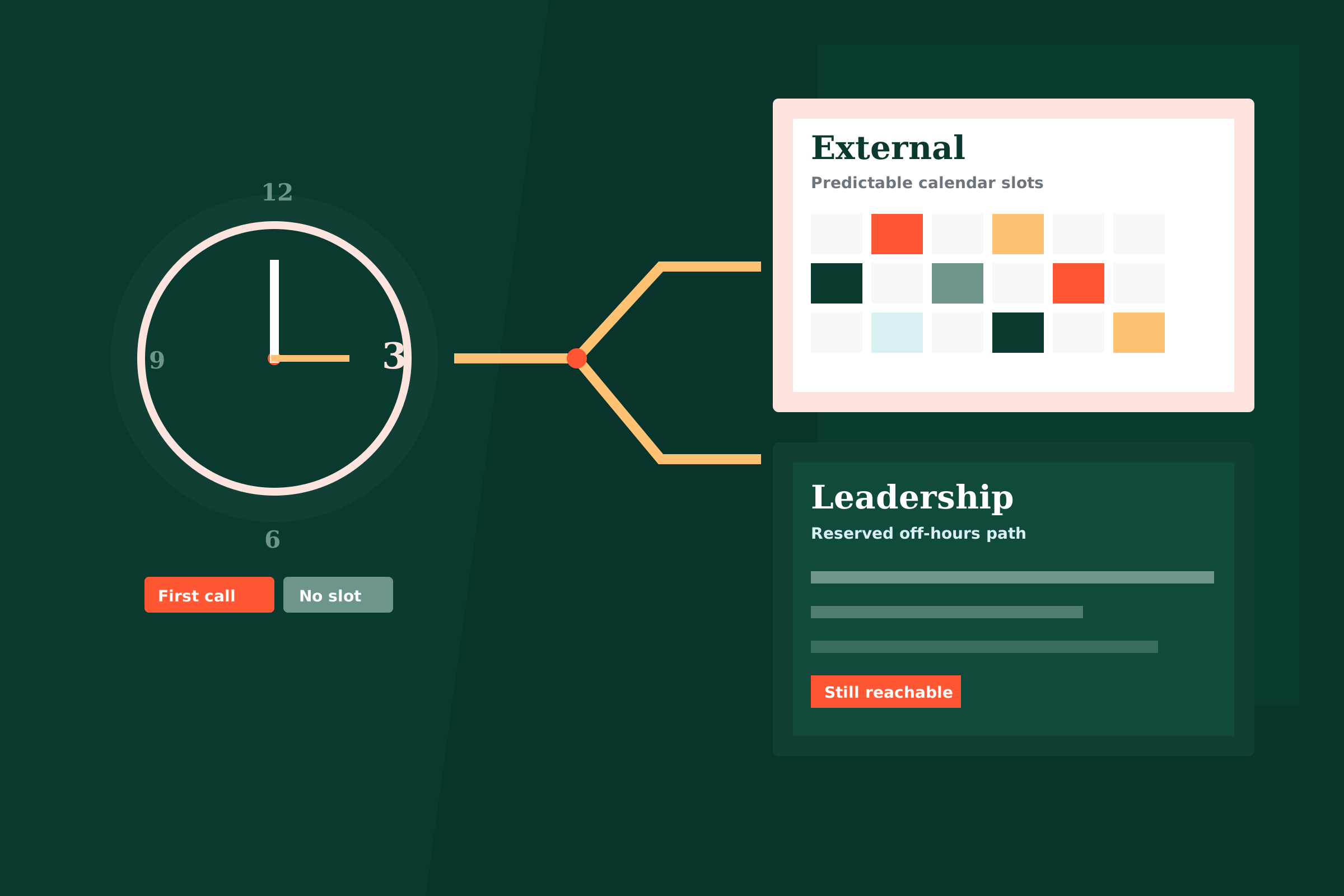
I used to accept first-time calls at 3 a.m. as long as the rationale held up.
A partner in another time zone had a real constraint. A first conversation could open a deal, a hire, or a collaboration. Saying yes felt like seriousness. It also felt cheap: one call, one night, one new relationship.
The rationale was often good. The policy was not.
When an exception becomes a channel
The first midnight call is an exception. The fifth is a channel.
External people learn the shape of your access faster than they learn the shape of your work. If the first interaction happens at 3 a.m., that becomes the implied service level. The next request arrives the same way. So does the one after that. Soon the people who do not know you have a more aggressive path to your attention than the people who do.
That is the friction. Not just tiredness.
A first-time partner has almost no shared context. They cannot tell a true emergency from a convenient one. They are optimizing for their own clock, their own deal cycle, their own anxiety. If you answer whenever the story sounds coherent, you are letting strangers set the urgency of your week.
Internal work pays for that. The next morning’s judgment is worse. The calendar fills with recovery instead of the work the call was supposed to enable. People who actually share the company’s duty wait behind people who do not.
Burnout is the later invoice. Friction is the daily one.
I wrote earlier about protecting optimal functionality rather than romanticizing sacrifice. This is the same lesson, applied to access. A founder who is always interruptible by outsiders becomes worse at the work those outsiders supposedly wanted.
Responsiveness is not the same as speed
Founders often treat responsiveness as proof of commitment. I did.
There is a version of this that is real. Early companies die from slowness. Time zones are real. A first conversation can be the difference between a live opportunity and a polite fade. I still believe in moving quickly.
But perpetual availability to external partners is not speed. It is an unpriced option. You are selling a twenty-four-hour response surface to people who have not earned it and will not protect it.
The people outside the company have a rational incentive to use that option. The people inside the company absorb the cost.
That is a bad trade even when every individual call was “worth it.”
The hinge I missed for years was simple. I treated a good rationale as enough. It is not. A first-time partner can make a coherent case at 3 a.m. and still be the wrong person to spend the night on. The question is not whether the story holds up. The question is who should be allowed to spend a scarce resource.
That is the same move I now use more generally: stay past the first answer and find the assumption the answer is standing on. “If the rationale is sound, take the call” sounded like discipline. It was actually an open inbox with a heroic story attached.
Route access by relationship
I now route access by relationship, not by how good the story sounds at night.
External contacts go through predictable calendar slots.
A first-time partner gets a clear window: regular hours, published availability, a booking path, and enough lead time to prepare. Repeat partners get the same structure. If the work is important, it can survive a calendar. If it cannot survive a calendar, it is usually not a first conversation. It is an emergency, and first-time partners almost never have a true emergency with you.
This is a stricter version of an older note I wrote on scheduling. The earlier mistake was treating the calendar as a convenience tool. It is a routing layer. It tells other people how to reach you without making them guess, and it keeps first conversations from arriving as interruptions.
Off-hours accessibility remains an internal expectation reserved for leadership.
The people who share the company’s actual duty still get the night. They have context. They can tell a real fire from a loud one. They are not using access to compensate for a missing process. They are using it because something inside the company cannot wait until morning without becoming worse.
That distinction is the whole system.
External access should be predictable. Internal leadership access should be real.
A calendar slot is not a snub
A scheduled conversation is a better first product than a 3 a.m. yes.
I show up prepared. The other person does too. The meeting has a duration, a purpose, and a next step. Nobody is performing urgency to get on the phone. Nobody is half-asleep trying to sound useful.
For a partner, predictability is respect. It says the conversation is worth doing well, not merely worth answering.
Off-hours access is a different product. It is expensive. It interrupts sleep, family, and the next day’s work. It should be reserved for people who will spend it carefully: the people whose job is to keep the company coherent when something breaks.
If everyone can spend it, no one will spend it carefully.
This is also clearer for the internal team. When the night is reserved for leadership, escalation has a meaning. It is not the fastest path to a decision. It is the path you use when waiting will make the failure worse.
The night still has a job
This is not a closed door. It is a filter.
A true external emergency still exists. A production incident that hits a customer. A legal or safety issue. A partner outage that is already live. Those are rare, and they are not first-time introductory calls.
The test I use now is closer to this:
- Do we already share responsibility for the system that is failing?
- Will waiting until the next calendar slot make the failure worse in a concrete way?
- Is the person asking someone who will still be accountable for the outcome tomorrow?
If the answer is no, it waits. If the answer is yes, I pick up.
That is how I keep the internal expectation honest. Leadership is not a status badge. It is a duty that includes being reachable when the company actually needs it.
The old rule optimized for being hard to refuse. The current rule optimizes for being possible to lead.
What this protects
The point is not comfort. The point is judgment.
A founder who is always interruptible by strangers becomes a queue of other people’s urgency. Internal work gets the leftovers. The team learns that the fastest way to get an answer is to escalate like an outsider.
Routing access reverses that. External work becomes scheduled and prepared. Internal leadership keeps a live channel. Sleep and attention stay intact enough to be useful the next morning.
I still move quickly. I just do not sell the night to people I have not met.