Most people stop when they produce an answer.
They consider an idea, reach a conclusion, feel a sense of resolution, and move on. The conclusion may be correct, but the mind’s desire for closure often arrives before the reasoning is complete.
Second-order metacognitive hyperfocus begins at that exact moment.
Do not continue thinking indiscriminately. Ask what assumption your answer depends on most. Find the assumption that, if false, would materially change the conclusion. Then determine whether more thought can evaluate it or whether reality must.
The process is:
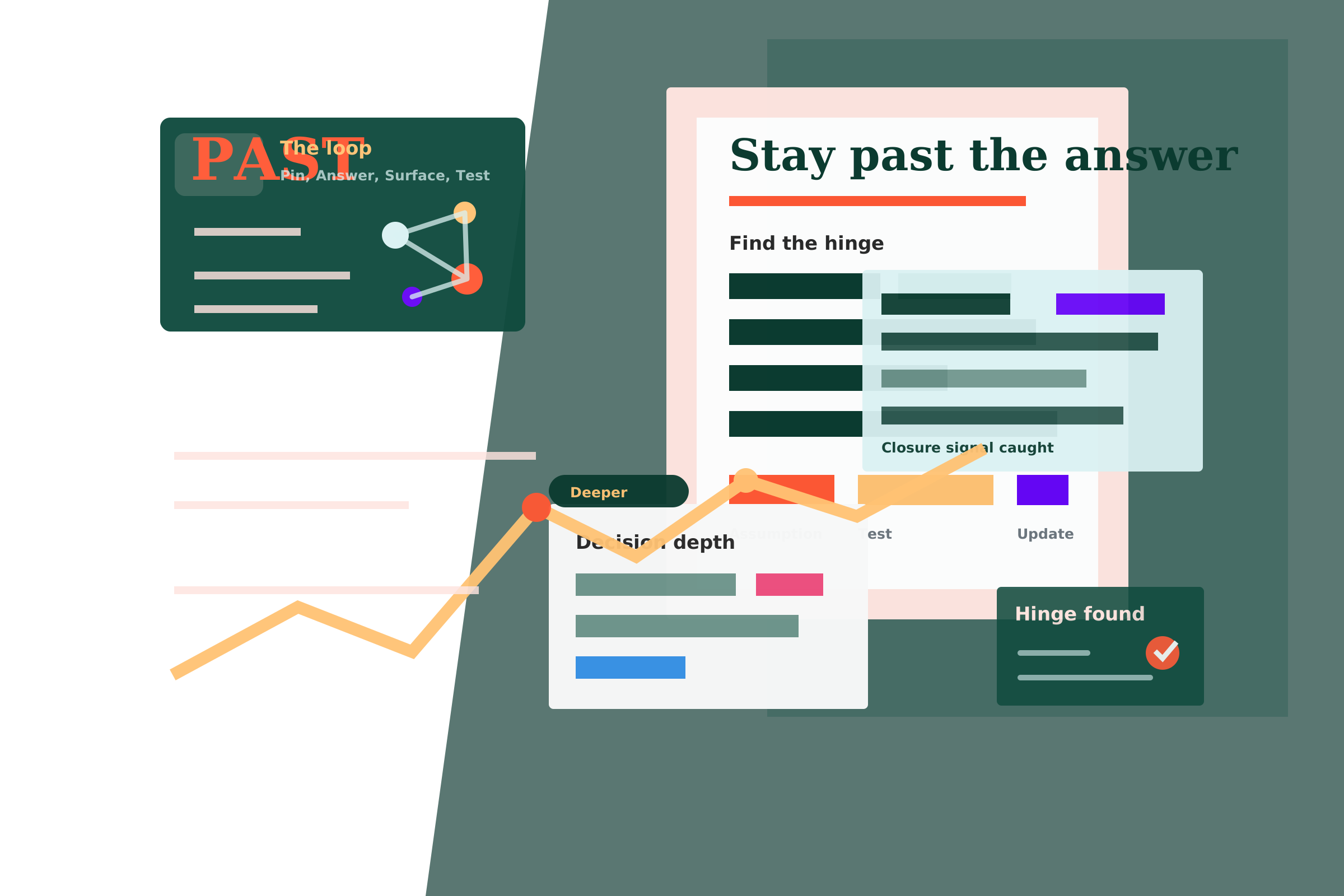
Pin the question. Answer provisionally. Find the hinge. Gather evidence. Update.
Stay past the answer—but only long enough to discover what the answer is standing on.
The five-step loop
1. Pin the question
Write one precise question.
Not:
Is this a good company?
Instead:
Will this specific customer pay at least $500 per month to solve this problem?
A vague question produces an equally vague cloud of thought. A precise question gives the mind one object to penetrate.
2. State the first answer
Write the answer in one sentence.
My current answer is yes because the problem is frequent, expensive, and currently handled manually.
Add a confidence level:
Confidence: 70%.
This converts an internal feeling into a visible claim.
3. Find the hinge
Ask:
What single assumption, if false, would most change my answer?
You do not need to examine every possible assumption. Find the one with the greatest power to reverse or materially modify the conclusion.
In the example, the hinge might be:
Customers complain about the problem, but they may not consider it important enough to pay $500 per month to solve.
That is now the center of the problem.
4. Find the cheapest available evidence
Ask:
What is the cheapest available evidence that would meaningfully update this assumption?
Do not ask people to answer a question that the world has already answered. Before creating new evidence, climb the evidence ladder:
Can deduction resolve it?
Some hinges are questions of mathematics, engineering, incentives, or logical contradiction. For example:
Can this product profitably serve a customer for $500 per month?
You may be able to answer that from infrastructure costs, implementation labor, support requirements, margins, and expected retention. No customer interview is required.
Does the answer already exist somewhere?
Look for competitor pricing and customer lists, existing products customers purchase, public reviews and complaints, Reddit, Discord, Slack, GitHub, and industry-forum discussions, job listings for people manually performing the work, internal support tickets or sales-call transcripts, search behavior, regulatory requirements, published budgets or procurement records, and previous failed attempts to solve the same problem.
This is not merely “research around the answer.” It is indirect observation of the market.
What does existing behavior imply?
Behavior is usually more informative than stated opinion. Suppose your hinge is whether customers consider this problem important enough to pay $500 per month. Before contacting anyone, determine:
- Are they already paying an employee to perform the task?
- How many hours per month does it consume?
- Are they purchasing several inferior tools?
- Are errors producing lost revenue, compliance risk, or customer churn?
- Have competitors successfully charged comparable prices?
- Are customers constructing elaborate workarounds?
If a company spends $3,000 per month in labor and software to manage the problem, that does not prove it will buy your product for $500. But it substantially raises the prior probability.
Exhaust the model before spending customer attention.
Before an idea, offer, or product reaches a customer, subject its central claim to two forms of pressure.
First, reason from first principles. Decompose the claim into the conditions that must be true:
- What mechanism is supposed to produce the result?
- What inputs, dependencies, and constraints does that mechanism require?
- Which failure modes can be derived without observing a customer?
- Under what conditions should the result not occur?
Then run a dialectical conversation. Give the strongest possible opposing model an equal hearing:
If the expected result does not occur, what is the most plausible explanation?
Steelman that explanation. Make it account for the same facts as the current answer. Alternate between the claim and its strongest counterclaim until the disagreement rests on one observable fact rather than a difference in wording, confidence, or preference.
Record the handoff as a falsifiable expectation:
WE EXPECT:
What should happen?

BECAUSE:
What mechanism should cause it?

ONLY IF:
What conditions must be present?

WE ARE WRONG IF:
What observation would materially weaken the model?
Cognitive exhaustion is not the feeling that nothing else can be said. It is an exit condition: no important uncertainty remains that deduction, existing evidence, an adversarial countermodel, or an internal test can resolve. The remaining hinge must depend on customer context, choice, or behavior.
This gate does not ensure that the product will work as expected. It ensures that the customer is testing the smallest genuinely external uncertainty rather than discovering a contradiction, missing dependency, or obvious failure that should have been found internally.
Only then create new evidence.
After exhausting relevant existing evidence, ask:
What information remains unavailable without observing a customer react to this particular offer?
That may require showing a prototype, sending a specific offer, requesting access to a workflow, asking for a letter of intent, asking for a paid pilot, or asking for an actual purchase. A paid pilot is not merely “asking users.” It is observing commitment. Ten customers saying they like an idea is weak evidence; one customer paying can be much stronger.
The objective is not perfect certainty. It is to distinguish between the most important competing explanations using the least expensive credible evidence.
5. Update or act
After gathering evidence, revise the answer:
Customers like the idea, but only two out of ten will pay. The opportunity may work at $100 per month, not $500.
Then either act or locate the next hinge.
The full loop is:
Question → First answer → Hinge → Evidence audit → Smallest unresolved test → Updated answer
That is the entire operating system.
Two loops
The five-step loop contains two distinct loops that serve different purposes.
The model loop
Question → provisional answer → hinge → existing evidence → revised answer
You can run this several times without contacting anyone. Deduction, research, and behavioral observation resolve many hinges before any customer conversation happens.
The reality loop
Remaining hinge → smallest necessary market interaction → observed behavior → revised answer
You enter this loop only when the unresolved information depends on private knowledge, contextual details, or future human behavior.
For the example above:
Will this specific customer pay at least $500 per month?
You can investigate whether they could rationally pay, whether similar companies already pay, whether the economics justify paying, and whether the problem appears sufficiently urgent—all without speaking to them. But you cannot fully reason your way to whether that particular customer will actually choose your particular offer. That final uncertainty is behavioral. At some point, reality has to cast the deciding vote.
Use PAST as the mnemonic
P — Pin the question.
A — Answer provisionally.
S — Surface the hinge assumption.
T — Test it against the cheapest available evidence.
“Stay past the answer” no longer means sitting with a thought indefinitely. It means completing one PAST loop before allowing yourself to mentally close the question.
When the hinge is not immediately visible
These four questions work as fallback tools. Use them only when the hinge is not immediately obvious:
What must be true? reveals assumptions.
Why might the opposite be true? reveals countermodels.
What have I excluded? reveals missing variables.
What happens next? reveals second-order consequences.
Once one of these exposes the decision-flipping assumption, stop searching broadly and concentrate on that assumption.
The minimum viable version
For an ordinary decision, write only five lines:
QUESTION:
What exactly am I deciding?

FIRST ANSWER:
What do I currently believe?

HINGE:
What assumption would most change that answer if false?

TEST:
What is the cheapest way to test it?

NEXT ACTION:
What should I do with the information available now?
This can take less than two minutes for a normal decision.
Scale the depth to the decision
Not every conclusion deserves deep metacognition.
Required depth increases with stakes, uncertainty, and irreversibility.
For a cheap, reversible decision, act on the first answer.
For an important but reversible decision, perform one PAST loop.
For an expensive or difficult-to-reverse decision, perform the full analysis across technical, economic, behavioral, and strategic layers:
- The technical layer: Can it work?
- The economic layer: Can it create and capture enough value?
- The behavioral layer: Will people actually adopt it?
- The strategic layer: What happens after other people react?
This prevents the method from becoming compulsive overanalysis.
The trainable behavior
The goal is not to achieve a prolonged state called “hyperfocus.” That framing can make the process feel mystical or dependent on mood.
The trainable behavior is much smaller:
Catch the moment of closure and require one model-changing operation before switching attention.
That operation could reveal a hidden assumption, a stronger opposing explanation, a missing variable, a downstream consequence, or an external test.
The process stops when another pass produces no important new variable, or when only action can resolve what remains. The refinement is to reach that stopping point faster by searching specifically for the hinge rather than exploring every branch.