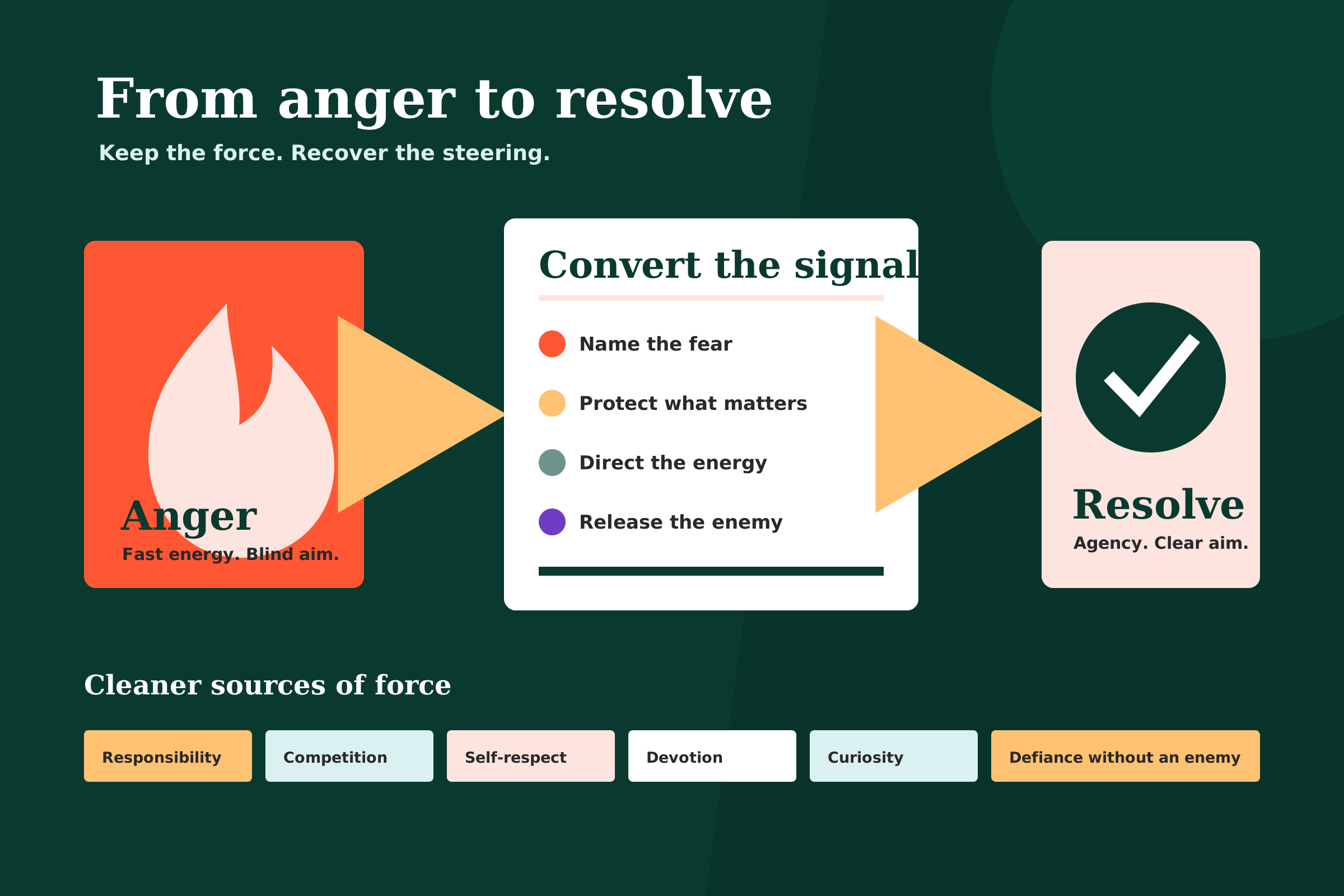
An entrepreneur can draw real strength from anger.
Anger can cut through anxiety, interrupt hesitation, and make action feel possible again. It can supply force at the exact moment fear is encouraging retreat. Advice that begins and ends with “calm down” misses this. It asks someone to surrender a working source of energy without offering another source strong enough to replace it.
The Dalai Lama identifies the problem more precisely:
Anger may seem to be a source of energy, but it’s blind. It causes us to lose our restraint. It may stir courage, but again it’s blind courage. Negative emotions, which often arise from a spontaneous impulse, cannot be justified by reason, whereas positive emotions can. Scientists suggest that constant anger and hatred undermine our immune system. Compassion, bringing inner strength, is good for our health.
The operative word is not energy. It is blind.
An entrepreneur does not need to become less forceful. The task is to preserve anger’s forward motion while recovering sight, restraint, and choice.
Anger does a real job
Anxiety and anger point the body in different directions.
Anxiety asks what might go wrong. It multiplies scenarios, raises the cost of uncertainty, and can turn preparation into avoidance. Anger simplifies the field. It identifies an obstacle, produces an impulse to approach it, and makes the person feel larger than the threat.
That transition can be useful. A founder who was afraid to make the call becomes willing to make ten. A rejection that felt like a verdict becomes a challenge. A stalled product becomes something to attack rather than something to hide from.
This is why anger can feel more honest than reassurance. It does not ask the entrepreneur to pretend the stakes are low. It agrees that something important is happening and supplies the energy to meet it.
But it achieves this by removing detail. A complicated market becomes an enemy. A doubtful customer becomes disrespectful. A teammate’s mistake becomes disloyalty. A competitor’s success becomes a personal offense. Anger creates motion by compressing ambiguity into a target.
That is powerful ignition and poor navigation.
The problem is not force; it is aim
Blind energy can produce a remarkable week and a damaged company.
It can drive a founder through a launch while making the team afraid to report bad news. It can create the courage to sell while making customer objections feel insulting. It can sustain long hours while quietly tying motivation to resentment, conflict, or revenge.
The danger is not only an outburst. It is dependency.
If anger becomes the only reliable route past anxiety, the mind eventually needs a fresh offense in order to work. Every obstacle must become an insult. Every disagreement must acquire a villain. The founder remains productive, but the company’s energy supply now depends on hostility.
This is an expensive operating system. It corrupts judgment precisely when judgment matters most.
Do not replace anger with passivity
Calm is valuable, but calm is a condition, not a motive. It can help someone see clearly without telling them why to move.
The better replacement is defiant resolve.
Defiant resolve keeps the refusal inside anger: I will not be ruled by this fear. I will not surrender the work because the conditions are difficult. It removes the need to punish someone, prove someone wrong, or remain emotionally inflamed.
Anger says, “I must defeat something.”
Resolve says, “I will accomplish something.”
Both can overpower anxiety. Only one can remain in command for years without requiring a continuous supply of enemies.
Six cleaner sources of entrepreneurial force
Defiant resolve is not one emotion. It is a way of combining several motives that can each recover agency without surrendering judgment.
Fierce responsibility
Responsibility moves attention away from injury and toward duty.
The founder asks: What do the people depending on me need me to handle well? That may include employees, customers, a family, investors, or the future version of the company. The question does not make the pressure disappear. It gives the pressure a direction.
Anger wants expression. Responsibility wants an outcome.
Competitive intensity
Competition can supply much of anger’s heat without making another person morally guilty.
The target can be a standard: a better product, a faster learning cycle, a clearer sales process, a lower failure rate. A competitor can remain evidence of what is possible instead of becoming an enemy who must be humiliated.
Healthy competitive intensity says, I intend to become exceptionally capable. It does not require, I need you to suffer so I can feel strong.
Self-respect
Anxiety often tries to negotiate: act later, prepare a little more, wait until confidence arrives.
Self-respect ends the negotiation. Fear can be present, but it does not get to choose my actions.
This is quieter than anger and more dependable. It makes courage behavioral rather than emotional. The entrepreneur does not need to feel invulnerable before sending the proposal, asking for the sale, or admitting that the current approach is failing.
Devotion to the mission
Anger is organized around what the founder opposes. Devotion is organized around what the founder serves.
A worthy mission can create intensity without constant agitation. The product deserves another iteration. The customer problem deserves to be understood. The team deserves clear leadership. The craft deserves patience.
Devotion also survives success. Revenge loses its organizing power once the rival is beaten or the critic disappears. A mission can continue generating direction after the original conflict is gone.
Curiosity
Curiosity is especially useful when anxiety comes from uncertainty.
Instead of asking, What if this proves I am failing? the founder asks, What would I need to observe to know why this is failing? The second question turns an identity threat into an investigation.
Curiosity does not have anger’s immediate drama, but it produces experiments, customer conversations, and corrected assumptions. It converts nervous energy into contact with reality.
Defiance without an enemy
Some situations deserve a hard refusal. The market may be indifferent. The odds may be poor. A constraint may be unfair. The entrepreneur can still say: This difficulty will not decide what I am capable of doing next.
The defiance is aimed at surrender itself, not at a person.
This may be the closest substitute for the strength anger provides. It retains the spine, the refusal, and the willingness to advance. It simply stops outsourcing motivation to an opponent.
Convert anger before it reaches another person
The practical task is not to prevent anger from appearing. It is to convert it before it makes a consequential decision.
When anger rises:
- State the anger without editing it. “I am angry because the investor ignored the follow-up.”
- Name the anxiety beneath it. “I am afraid the company will not secure enough capital.”
- Identify what the anger is trying to protect. “I want the company and the team to have enough runway to prove the product.”
- Rewrite the motive without an opponent. “One investor does not determine whether I can build a credible financing path.”
- Choose a concrete action that changes reality. Improve the evidence, contact five better-fit investors, revise the financing plan, or close another customer.
- Delay high-consequence decisions about people. Do not send the furious message, fire someone, or redesign a partnership while the emotional field is still compressed.
The conversion does not deny the original anger. It extracts the information and energy, then refuses its proposed target.
Give anger a narrow job
Anger can identify a violated boundary, an avoided truth, or a value that has gone undefended. That is enough responsibility for one emotion.
It can raise the alarm. It should not run the response.
Once the signal arrives, judgment has to determine whether the perceived offense is real, whether action is warranted, and which action serves the company rather than the founder’s immediate need for release.
This distinction is particularly important in leadership. A founder’s private emotional state becomes a public operating condition for everyone nearby. If anger governs access, disagreement, or status, the team learns to manage the founder instead of reporting reality. The company becomes calmer on the surface and less truthful underneath.
Restraint is therefore not softness. It protects the information system a leader depends on.
A founder should not need an enemy
Building a company already contains enough difficulty. There is no need to manufacture villains to remain energized.
Responsibility can provide weight. Competition can provide intensity. Self-respect can provide courage. Devotion can provide endurance. Curiosity can provide movement through uncertainty. Defiance can provide the refusal to quit.
Together, they can do the useful work anger was doing without giving blindness executive authority.
None of this means serious or persistent anxiety is merely a productivity problem to overpower. Professional support can be part of responsible leadership too. The narrower point is that an entrepreneur does not have to choose between anxious paralysis and angry motion.
There is a third posture: fully aware of the fear, unwilling to be governed by it, and disciplined enough to act without needing someone to hate.
Let anger start the engine when it must. Let purpose, evidence, and restraint steer.