For much of the time I have lifted weights, a set had an obvious ending: I kept going until I could not complete another repetition.
That rule felt honest. If I stopped voluntarily, perhaps I had left progress on the table. Failure was proof that the set counted.
At one point I could bench press 190 pounds for three sets of six. After several inconsistent years, my current strength is below that mark. When I began designing a three-day program around strength, functionality, and reliable energy for building a company, my instinct was familiar: recover the old numbers by pushing every set as far as it could go.
Then I encountered repetitions in reserve, usually abbreviated RIR.
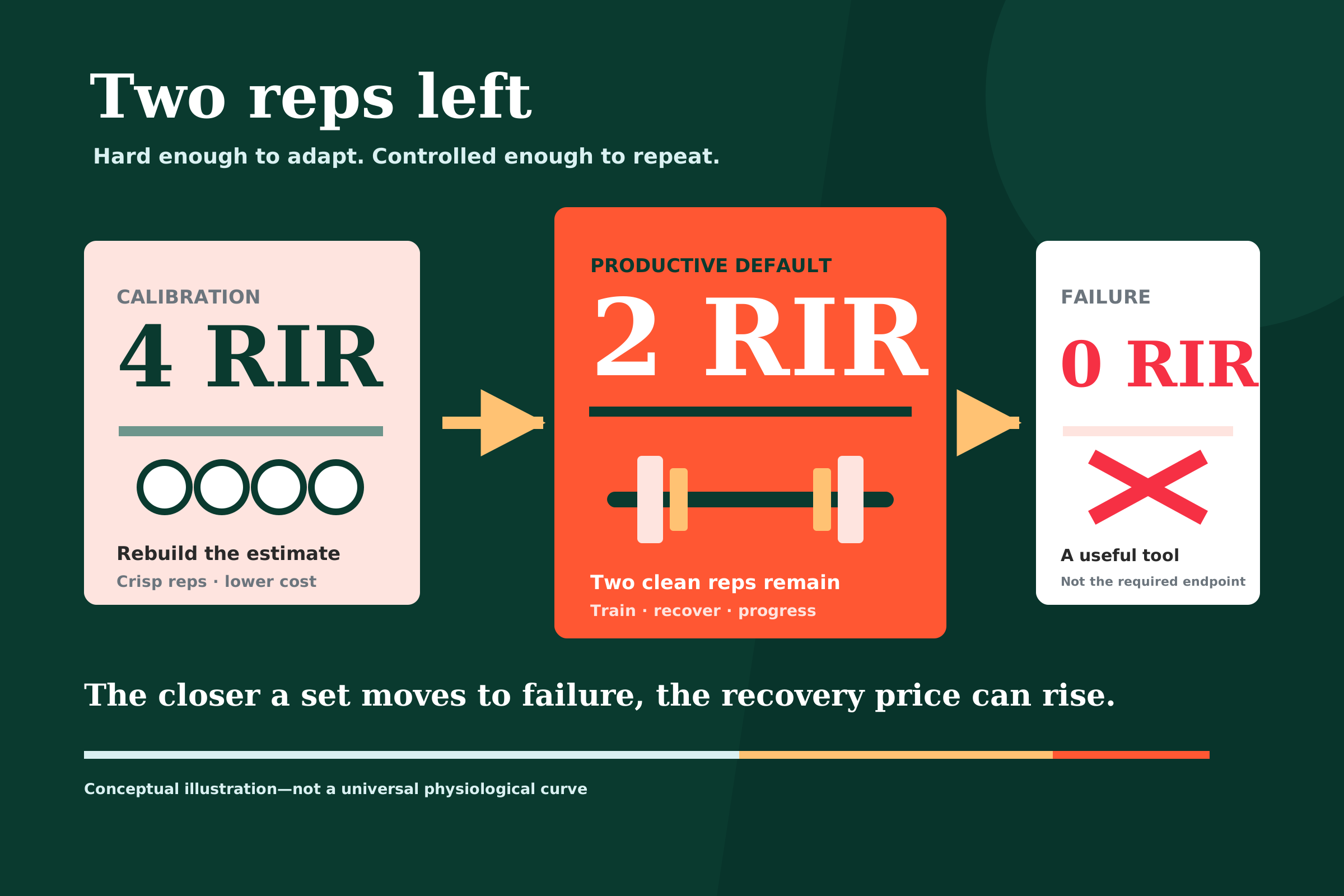
The most interesting prescription was 2 RIR: end a set when I believe I could still complete approximately two technically sound repetitions.
It initially sounded like quitting early. It now looks more like a change in the unit of optimization. Instead of asking how much exhaustion I can extract from this set, RIR asks how much high-quality work I can accumulate, recover from, and progressively repeat across the session, the week, and the rest of my life.
What 2 RIR means
RIR estimates how many additional repetitions remain before momentary muscular failure. The estimate concerns repetitions completed with the same range, position, and control—not shortened, assisted, or improvised grinders.
| RIR | Approximate RPE | What it means |
|---|---|---|
| 4 | 6 | About four clean repetitions remain |
| 3 | 7 | About three remain |
| 2 | 8 | The set is hard, but approximately two clean repetitions remain |
| 1 | 9 | One credible repetition remains |
| 0 | 10 | No additional clean repetition is available |
The RPE mapping is a coaching convention, not an exact physiological conversion. It was formalized in research on the RIR-based resistance-training RPE scale and later described as a practical method for prescribing and adjusting resistance training.
The word clean matters. If another squat would require losing position, another bench repetition would need a spotter, or another deadlift would require abandoning the established setup, that is not a repetition in reserve for this purpose.
At 2 RIR, I am not stopping because the set became uncomfortable. I am stopping because only about two more repetitions of the agreed movement remain.
Failure proves effort, not adaptation
I had quietly combined three different ideas:
- The set felt maximally difficult.
- The set created a productive training stimulus.
- The set reached momentary failure.
Those are related, but they are not identical.
Failure answers a narrow question: Could I complete another repetition right now? It does not reveal whether the final repetition produced a uniquely necessary adaptation, whether it reduced the quality of the next set, or whether the same long-term result could have been earned at a lower fatigue cost.
The 2026 American College of Sports Medicine position stand synthesized 137 systematic reviews covering more than 30,000 healthy adults. Resistance training improved strength, muscle size, power, endurance, gait, balance, and other measures of physical function. But training to momentary fatigue did not consistently improve outcomes. The authors also made an important distinction: the evidence does not identify one exact RIR target that is universally optimal.
That is the intellectually honest frame. The research does not prove that everyone should always stop at precisely two. It does show that failure is not the switch that turns progress on.
The last repetitions carry a larger fatigue bill
The strongest case for RIR is not that the final repetitions are worthless. It is that their cost can rise faster than their usefulness for the goal at hand.
In a randomized crossover experiment, 24 resistance-trained men and women completed six bench-press sets at 75% of one-repetition maximum. Immediate lifting-velocity loss was about 25% after failure training, 13% at 1 RIR, and 8% at 3 RIR. Perceived effort, discomfort, soreness, and recovery also worsened as the sets moved closer to failure. The groups had recovered by 48 hours, but the acute cost was clearly graded. Read the study.
Another crossover study had trained men perform bench-press work at 80% of one-repetition maximum. Using 3 RIR preserved more repetitions and work at a higher average velocity and lower perceived effort than taking all five sets to failure. The study did not find a difference in its 24-to-72-hour recovery measures, which is a useful limit on the claim: RIR improved the session, but did not win every measured recovery outcome. Read the study.
The broader evidence points in the same direction. A meta-analysis of acute fatigue found that failure training produced larger declines in biomechanical performance, larger metabolic responses, more muscle-damage signaling, and higher perceived effort than nonfailure training. A separate squat study found greater between-set velocity loss and peripheral-fatigue markers after failure work. Read the squat study.
This does not make fatigue bad. Training is a stressor; some fatigue is part of the transaction. The question is whether I am paying for adaptation or merely paying to prove that I can suffer.
What the strength evidence says
For strength, the literature is remarkably unfriendly to the idea that failure must be the default.
- A 2022 meta-analysis found no significant overall difference between failure and nonfailure training for strength or hypertrophy.
- A 2016 strength meta-analysis found a small statistical advantage for nonfailure training, but judged the practical difference unlikely to be meaningful.
- A 2026 systematic review and meta-analysis covering 20 studies and 556 participants found a small advantage for nonfailure training in dynamic strength, with no significant differences in isometric strength, hypertrophy, endurance, or power.
- In a 16-week controlled trial, failure and nonfailure groups produced virtually identical improvements in bench-press and squat one-repetition maximum. Read the trial.
The evidence is not unanimous. A small six-week study of elite junior team-sport athletes found greater bench strength and bench-throw gains from a four-by-six failure protocol than an eight-by-three nonfailure protocol, even though total repetitions were matched. The set structure and rest density also differed, so failure was not the only distinction. Read the counterexample.
That counterexample matters. “Failure is never useful” would be as careless as “failure is always necessary.” The better conclusion is narrower: strength can be built without routinely exhausting every set, and the quality of the complete program matters more than a ritualized endpoint.
Muscle growth is where the argument becomes more nuanced
Strength and hypertrophy are related, but they are not the same outcome.
An exploratory 2024 series of meta-regressions found little relationship between estimated RIR and strength gain across a broad range, while muscle growth tended to improve as sets ended closer to failure. The authors emphasized that RIR had to be reconstructed from study descriptions, model fit was modest, and the precise dose-response relationship remains uncertain.
Direct trials help narrow the question:
- In 18 resistance-trained adults, leg presses stopped at 2 RIR and leg extensions stopped at 1 RIR produced almost identical average quadriceps-thickness gains to failure training over eight weeks. Failure caused greater velocity and repetition loss. Read the trial.
- A 2026 trial in trained adults likewise found negligible strength and hypertrophy differences between 1–3 RIR and failure on unilateral leg extensions. Read the trial.
- A 2025 single-set study compared 2 RIR with failure across nine exercises in 42 resistance-trained adults. Strength and local endurance improved similarly. Some hypertrophy measures modestly favored failure, suggesting that the trade can change when only one set is performed. Read the study.
- In an earlier study of untrained men, high- and low-intensity knee-extension protocols produced similar growth and strength whether they ended at failure or voluntary interruption. Read the study.
Load matters too. In a unilateral knee-extension study, failure and nonfailure work at 80% of one-repetition maximum produced similar hypertrophy. At 30%, stopping very far from failure underperformed failure training. Read the load-dependent study.
This is why “stay two reps away” should not harden into a religion. With moderate or heavy compound work, 2 RIR can be very demanding. With a very light weight and a long set, stopping too early may leave too little stimulus. A bodybuilder prioritizing every possible increment of muscle growth may rationally use more 0–1 RIR work than a founder prioritizing strength, power, function, and dependable recovery.
Velocity-loss research shows the trade in another way
RIR is subjective. Velocity-loss research studies a related but distinct question: how much should repetition speed be allowed to decline within a set?
In one eight-week squat trial, allowing 20% velocity loss produced similar strength gains and better jump improvement than allowing 40% loss, despite completing 40% fewer repetitions. The 40% group developed more hypertrophy. Read the trial.
A larger trial compared 0%, 10%, 20%, and 40% velocity-loss thresholds. Strength gains did not significantly differ between groups. Higher thresholds produced more hypertrophy, while the 40% condition also reduced early rate of force development. Read the trial.
Velocity loss and RIR are not interchangeable, and bar speed is not a perfect RIR detector. But these studies reveal the same underlying trade: performing more fatiguing repetitions can favor muscle growth in some contexts without producing proportionally greater strength or power.
Why two is a useful operating point
If failure is unnecessary, why not stop at 4, 6, or 10 RIR?
Because avoiding failure is not the same as avoiding hard training.
The closer-to-failure hypertrophy evidence argues against turning every set into comfortable practice. The acute-fatigue evidence argues against turning every set into a maximal test. Two RIR sits between those errors. It is close enough that moderate and heavy sets are highly demanding, but far enough away to avoid the failed repetition and much of the deterioration that precedes it.
That does not make 2 RIR a natural constant. It makes it a sensible default that can move with the exercise and objective:
- Heavy, technical barbell compounds may justify 2–4 RIR, especially during calibration or while training alone.
- Moderate-repetition presses, rows, chin-ups, and squats often fit well around 1–3 RIR.
- Light, high-repetition or isolation work may sometimes need 0–2 RIR to create the intended stimulus.
- Power work should stop much earlier, at the first meaningful loss of speed or control.
The number is useful because it creates a shared operating rule. It replaces “go hard” with something I can record and compare.
RIR makes progression more informative
Suppose my prescription is two bench-press sets of four to six repetitions at 2 RIR.
I complete six clean repetitions and believe an eighth would succeed while a ninth probably would not. I rack the bar after six. I do not perform the two reserved repetitions.
Three different outcomes now mean different things:
- Six repetitions at roughly 4 RIR: the load was conservative.
- Six repetitions at roughly 2 RIR: the target was achieved.
- The fifth repetition becomes a severe grinder: I probably reached 0–1 RIR and overshot the target.
Progress can then be defined without failure. If the same load produces more repetitions at the same RIR, I am stronger. If a heavier load produces the same repetitions at the same RIR, I am stronger. The effort target prevents a good day and a bad day from being treated as identical merely because the number on the bar was identical.
That is one reason autoregulation interests me. In an eight-week study of resistance-trained men, both fixed-percentage and RPE-based loading improved squat and bench strength, with no statistically significant between-group differences. RPE-based loading showed a possible small individual advantage, but the sample was small. Read the study.
RIR is not a replacement for programming. It is a way to make the programmed load answer to the condition of the person lifting it that day.
Can I actually estimate two repetitions?
Not perfectly.
A review covering 12 studies and 414 participants found that people underpredicted the number of repetitions remaining by about one repetition on average, with enormous variation. Accuracy improved closer to failure and in lower-repetition sets. Training experience did not consistently eliminate the error. Read the review.
Individual studies make the pattern more concrete:
- Across squat, bench press, overhead press, and prone row, trained men estimated 2 RIR most accurately at 85% of one-repetition maximum. Accuracy worsened with lighter 65% and 75% loads. Read the study.
- In trained men and women benching at 75%, estimates of 1 and 3 RIR missed by about 0.65 repetitions on average, with a slight tendency to stop earlier than necessary. Read the study.
- Another study found that RIR predictions improved in lower-to-moderate repetition sets and when participants were closer to failure. Read the study.
- A 2026 experiment found that six familiarization sessions improved estimation error in both younger and older adults. Read the study.
RIR is therefore a trained judgment, not a sensor reading. Being off by one repetition does not destroy the method. Consistently calling 5 RIR “2 RIR” can underdose training; consistently calling failure “2 RIR” defeats its fatigue-control purpose.
My calibration rules are simple:
- Use a repeatable setup, range of motion, and tempo.
- Record the estimate immediately after the set.
- Count only repetitions that would preserve the same technique.
- Treat a major slowdown, altered range, or lost position as evidence that the estimate was too aggressive.
- Compare the log across weeks rather than demanding perfect precision today.
- If deliberate failure calibration is ever used, choose a safely constrained, low-consequence movement—not a solo barbell lift with an uncertain exit.
Why this fits the way I want to train
My objective is not merely to maximize a gym number. I want a high reserve of strength and physical capability while retaining enough energy to think, decide, and build for the rest of the day.
That leads to three constraints: three full-body sessions per week, approximately 60 minutes per session, and no routine training choice that predictably damages workday function.
Failure on an early bench, squat, or deadlift set can reduce the quality of several movements that follow. A full-body program makes that opportunity cost visible. Two RIR lets the main lifts remain heavy and progressive without allowing the first exercise to consume the entire session’s recovery budget.
My current progression intentionally begins farther away:
- Weeks 1–2 use 3–4 RIR to establish current capacity.
- Weeks 3–4 use 2–3 RIR.
- Productive weeks use mostly 2 RIR.
- Reduced-readiness days return to approximately 4 RIR.
This is particularly important when returning after inconsistent training. Historical strength demonstrates familiarity; it does not prescribe today’s load or recovery capacity.
There is no trial showing that 2 RIR improves a founder’s afternoon cognition or company performance. That connection is my inference from the evidence on acute fatigue, session quality, recovery, and autoregulation. I intend to test it with my own strength log and a consistent workday-energy measure rather than present it as established physiology.
Failure still belongs in the toolbox
Failure is not a moral defect, and RIR is not permission to avoid effort.
Failure can be reasonable when:
- a safely constrained isolation exercise makes the consequence small;
- a hypertrophy-focused block deliberately accepts more fatigue;
- a minimalist single-set program needs to extract more from that one set;
- a controlled test is needed to calibrate capacity;
- or a coach has designed it for a specific adaptation and recovery context.
It is a poorer default when:
- the exercise is a heavy, technical compound lift;
- the lift is performed alone without a safe failed-repetition strategy;
- power and repetition speed are the objective;
- important work remains later in the session;
- or recovery outside the gym is already constrained.
The evidence does not establish that failure itself necessarily causes injury. The stronger argument is about performance and fatigue: failure often asks for more recovery without reliably purchasing more strength.
The limits matter
The literature is useful and still incomplete.
Many studies are short, small, and conducted in young adults. Exercises, loads, set counts, training status, definitions of failure, and achieved proximity to failure vary. Some “nonfailure” groups stop one repetition short; others stop many repetitions short. RIR is sometimes measured, sometimes estimated afterward, and sometimes inferred from velocity loss.
The latest evidence improves the map without identifying a universal coordinate. Exactly 2 RIR is not proven superior to 1 or 3 RIR for every movement, person, or goal. Its value is practical: it is close enough to make moderate and heavy resistance training productive, far enough to control much of failure’s acute cost, and simple enough to apply without laboratory equipment.
Research map
The studies below are the outside evidence that most changed or tested my view.
Position stands and evidence syntheses
- ACSM resistance-training position stand, 2026: overview of 137 systematic reviews; failure did not consistently alter outcomes, and no exact universal RIR target was established.
- Nonfailure versus failure meta-analysis, 2026: 20 studies and 556 participants; a small dynamic-strength advantage for nonfailure, with no significant difference in several other outcomes.
- Failure versus nonfailure meta-analysis, 2022: no overall strength or hypertrophy difference; possible modifiers include training status and whether volume was equated.
- Failure, strength, hypertrophy, and power meta-analysis, 2021: failure was not required; apparent hypertrophy advantages weakened when volume was equated.
- Proximity-to-failure and hypertrophy meta-analysis, 2023: momentary failure was not superior, while definitions and actual proximity remained inconsistent.
- RIR dose-response meta-regressions, 2024: little strength relationship across estimated RIR, but closer proximity tended to favor hypertrophy; exploratory and not precise enough to identify a magic number.
- Acute-fatigue meta-analysis, 2022: failure increased performance loss, metabolic stress, muscle-damage markers, and perceived effort.
- Velocity-loss systematic review and meta-analysis, 2023: greater velocity loss increased acute fatigue and hypertrophy while tending to impair jump, sprint, and submaximal-velocity outcomes.
Controlled training and fatigue studies
- Failure versus nonfailure over 16 weeks: similar bench and squat strength gains with different endurance and power responses.
- The elite-junior-athlete counterexample: a failure protocol beat a differently configured nonfailure protocol for bench strength and power over six weeks.
- Trained adults at 1–2 RIR versus failure: similar quadriceps growth, with more velocity and repetition loss at failure.
- Single-set 2 RIR versus failure: similar strength and endurance; some hypertrophy measures modestly favored failure.
- Load-dependent failure study: high-load nonfailure performed similarly to failure, while very-light work stopped far from failure underperformed.
- Volume-matched failure versus nonfailure: similar strength and hypertrophy when total repetitions were matched.
- Bench fatigue at failure, 1 RIR, and 3 RIR: acute velocity loss and perceptual cost rose closer to failure.
- Bench-session performance at 3 RIR versus failure: RIR preserved work and velocity at lower perceived effort.
- Failure versus nonfailure recovery time course: the demanding failure protocol caused greater acute impairment and slower recovery.
- Velocity-loss squat trial: lower fatigue achieved similar strength and better jump gains with fewer repetitions; higher fatigue produced more hypertrophy.
- Four velocity-loss thresholds: similar strength across thresholds, more hypertrophy at higher thresholds, and a rate-of-force-development cost at the highest threshold.
RIR measurement and calibration
- Original RIR-based RPE scale study: established the familiar RPE 10 = 0 RIR, RPE 9 = 1 RIR, and RPE 8 = 2 RIR mapping.
- Prediction-accuracy review: average underprediction of about one repetition, with very high variability.
- RIR across four common exercises: better 2-RIR accuracy with heavier loads than lighter loads.
- Bench-press RIR accuracy: trained participants estimated 1 and 3 RIR within about one repetition on average.
- Proximity and repetition count affect RIR accuracy: estimates improved closer to failure and in lower-repetition sets.
- Methods for controlling proximity to failure: explains why momentary failure, volitional interruption, percentage of maximum, velocity loss, and self-reported RIR should not be treated as interchangeable.
The shift
I used to think the failed repetition authenticated the work before it.
Now I see the decision to rack the bar with two clean repetitions available as a different kind of discipline. The set is still hard. The load still progresses. The difference is that exhaustion no longer gets to masquerade as the objective.
Failure asks, What can I survive in this set?
Two RIR asks, What can I repeat, progress, and recover from for years?
That is the stronger question for the kind of strength I want.
This article is an educational account of my training framework, not individualized medical advice or a substitute for qualified coaching or clinical care.