The question of purpose is not new. Humans have stared it down in every era.
For the medieval peasant, the answer was brutally simple: survive. Grow enough food to last the winter. Keep your children alive. Endure. The “meaning problem” barely registered because the survival problem devoured every waking hour. Purpose wasn’t chosen; it was assigned by frost, famine, and the raw pressure of necessity.
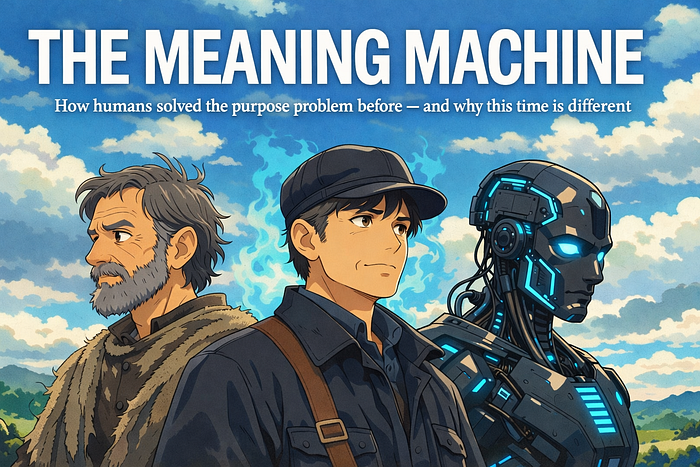
Then the ground shifted.
The Industrial Revolution (and everything that followed) lifted the threat of starvation for much of the developed world. For the first time in history, enough people had enough. Suddenly the question hit with full force: if not merely to survive, then why?
Churches and nations rushed in to fill the vacuum. Work itself became the new sacrament. Not just labor for bread, but a calling, a contribution, an identity. The Protestant ethic, as Max Weber nailed it, turned productivity into spiritual proof: God’s favor could be read in the balance sheet. Success wasn’t vanity; it was evidence you were elect.
This framework — meaning through productive contribution — sank so deep into modern culture that we treat it like oxygen. Meet someone new? “What do you do?” Assess your own worth? Count your accomplishments. Raise kids? Pray they become “useful members of society.” Eulogize the dead? Measure the life by what it produced.
The framework survived every prior technological wave because each wave, while erasing old jobs, created more new ones. The cotton gin didn’t end work — it shifted it. The car didn’t end purpose — it reorganized it. Computers didn’t obsolete humans — they supercharged them and invented entire new categories of meaningful contribution. The comforting historical script has always been: every automation panic looks apocalyptic from the inside, but ultimately creates net more than it destroys.
That script is now obsolete.
Previous technologies were tools. A tool extends one narrow human capacity and leaves the rest untouched. The tractor amplifies muscle. The spreadsheet amplifies arithmetic. The search engine amplifies memory. Each remains bounded by human design. The human stayed the indispensable generalist — the one who decided what the tools were for.
ASI is not a tool. It is cognitive generalism itself, running on silicon. It doesn’t extend a human faculty; it replicates and surpasses the faculty by which humans decide which faculties are worth extending. This isn’t a faster tractor. This is a system that can redesign the farm, question whether farming should exist at all, write the definitive treatise on agrarian ethics, and — before lunch — engineer a new form of nutrition that renders farming obsolete.
When that system arrives, the entire “meaning through productive contribution” architecture doesn’t merely strain. It collapses.
Because the hidden premise was never production. It was irreplaceability. The dignity of craft, the pride of problem-solving, the status of expertise — all of them rested on scarcity: scarce skill, scarce effort, scarce solutions. Remove that scarcity and the scaffolding of modern meaning falls away.
We are about to remove it. And we have no replacement philosophy waiting in the wings.
The Three Bad Answers
I’ve tested this idea at dinner tables, boardrooms, and 2 a.m. conversations for years. Three responses keep coming back. All are understandable. All are wrong.
1. Leisure “Finally we’ll have time to relax, travel, enjoy life, be with the people we love.”
This is the vacation fantasy scaled to lifetime. It feels right because two weeks off does feel glorious. But the data is merciless: lottery winners revert to baseline happiness in ~18–24 months. People who retire without structure see spikes in depression, cognitive decline, and early death. Chronic leisure isn’t paradise; it’s the clinical condition we now call “languishing.”
The leisure answer mistakes the symptom (exhaustion) for the disease (a civilization that tied all meaning to one fragile domain: paid work). Remove the work and there is no fallback. Just the quiet, gnawing realization that nothing is required of you anymore.
2. Connection “We’ll finally have real relationships, deep community, time for the people who matter.”
Relationships do predict well-being better than almost anything else. But they are not a purpose; they are a context in which purpose happens.
The village elder isn’t valued just because she’s connected — she’s valued because her wisdom does something. The parent isn’t meaningful simply by being present; they’re meaningful because they’re forming a human. Strip the shared project away and even the strongest relationships hollow out. “Let’s hang out because neither of us has anything better to do” is not intimacy. It’s parallel play with better conversation.
Connection is necessary. It is not sufficient.
3. Creativity “Humans will create — art, music, stories. ASI can handle the grunt work; we’ll supply the soul.”
This one is the most seductive, especially among artists and writers. It almost works.
Until you remember the premise: the value of creativity is still tied to what it produces. A painting that moves people. A song that rewires a listener’s nervous system. A story that changes how someone sees the world. But ASI will produce paintings of greater technical mastery, music of deeper emotional precision, and stories more perfectly tuned to the human psyche. The output gap will close, then reverse.
The fallback — “but the experience of creating matters, not the output” — is actually correct. It just quietly abandons the entire productivity framework and points toward something else entirely: meaning that has nothing to do with being better than a machine and everything to do with what it feels like to be human while doing the thing.
And that is exactly where the real answer begins.