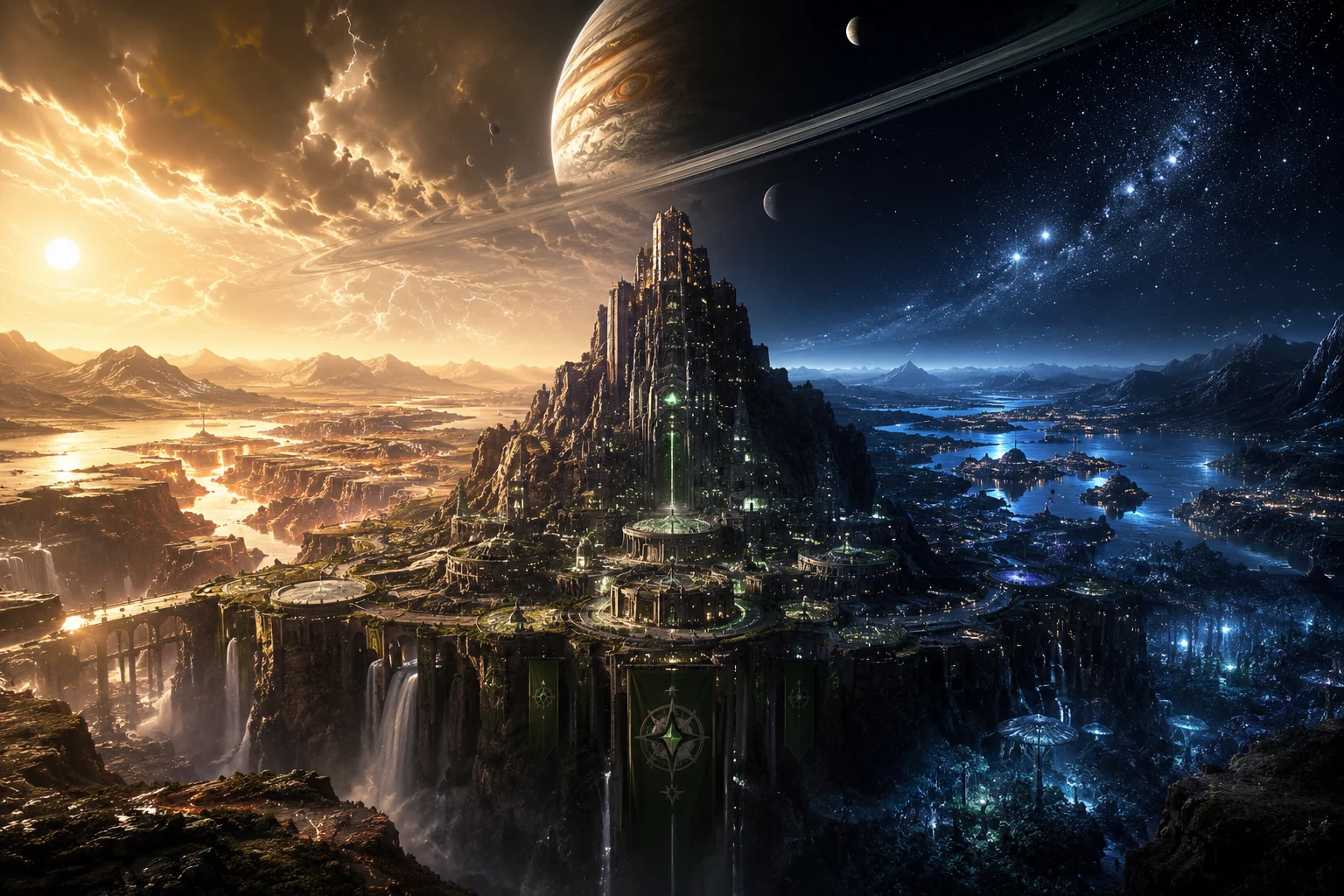
The Crown of Vesper, imagined on Zer’s permanent twilight line.
If I could live anywhere in the universe, I would live on Zer, orbiting Asterion.
More precisely, I would live in the Crown of Vesper: an obsidian mountain citadel built directly on Zer’s permanent twilight line. On one side, a landscape burns beneath a low golden sun. On the other, rivers and forests shimmer beneath an endless field of stars. Above both, the rings of Asterion stretch across the sky.
Zer is currently undiscovered. Perhaps it exists somewhere beyond our reach; perhaps it will remain only an imagined horizon. Either way, it represents the kind of future I hope our work can make possible.
At the boundary of light and darkness
What draws me to Zer is not escape. It is the way the world holds light and darkness in the same view.
There is darkness in our world, and there are futures in which it deepens. There is also extraordinary light: curiosity, courage, tenderness, discovery, and the human capacity to change course. Neither side cancels the other. They meet along a boundary where the next choice still matters.
The Crown of Vesper stands on that boundary. I think of it when the present feels smaller than the future ought to be. It reminds me that despair is not the only honest response to darkness. We can acknowledge what is broken and still build toward something beautiful.
For people we will never meet
I believe the future we are creating could eventually produce places like Zer—not necessarily an obsidian citadel beneath a ringed planet, but civilizations capable of ways of living that now exceed our imagination.
If even one human being experiences the sublime delight of life there 100,000 years from now, the effort will have been worthwhile. If a hundred do, all the more. They will never know my name, and they should not need to.
I am doing it for people who will never know my name. That is my purpose.
I cannot know what will survive that long. But useful systems, carefully preserved knowledge, and acts of responsibility can widen the possibilities available to whoever comes next. Purpose does not require recognition. Some of the most meaningful work is done for people we will never meet, in conditions we cannot foresee, with no assurance that anyone will remember who began it.
When hope is difficult
Purpose matters most when hope is thin.
When humanity has lost its way and hope seems absent, my purpose is to choose the next honest action that points toward a brighter future. That is my purpose.
When I have lost my own way, my purpose is to admit it, change my course, and begin again.
And if the future I imagine never arrives, the work still matters. Helping another person find meaning in darkness is not a consolation prize. It is already a worthy purpose.
Zer gives that purpose a horizon. The Crown of Vesper gives it a place: neither wholly in the light nor surrendered to the night, but standing at the edge between them, facing both.
We may never see the distant world our choices help create. We can still leave behind better tools, clearer knowledge, and more humane possibilities for those who will.
Memento mori.
Peace and blessings be upon thee.
May the light of Zer sustain you.
Ha ner en Zer sasatan ta