A founder is preparing to sell a new product: software that turns approved work artifacts—release notes, repositories, project documents—into source-backed professional updates.
“Before I sell it, do I need to read all of Pete Kazanjy’s Founding Sales?” he asks.
The respectable answer is yes. Serious people read the book. Lazy people ask for the summary.
But that answer confuses a ritual with a result.
The founder does not need every part of the book equally today. He needs to decide:
- Who should buy the product first?
- What painful outcome should it sell?
- How should prospects be approached?
- What should happen during a sales call?
- What should the founder charge?
- How should the first customers be onboarded?
- Which metrics would prove that the motion is working?
- Which lessons matter before ten customers rather than after hiring a sales organization?
Those questions map to different parts of Founding Sales. The book’s official structure moves from narrative and ideal customer profile through prospecting, pitching, pricing, customer success, and eventually sales management. It explicitly separates the founder’s first roughly 30 customers from the later work of scaling a team. Kazanjy also warns that reading about selling is not sufficient; fluency comes from actually doing it. The official site now even offers an AI sales coach described as being trained on the book and Kazanjy’s other work.
Imagine a system with legitimate access to the full source. It constructs a source-grounded representation of the book, interprets that model against the product’s current position, proposes a concrete sales process, answers objections, and points to the exact passages that deserve direct reading. The founder then conducts 20 sales conversations and returns with the transcripts, outcomes, and surprises. The system reinterprets the same book against what actually happened.
That founder did not “avoid learning.” He replaced one linear pass through a general-purpose artifact with an adaptive conversation between a source, a live problem, and reality.
Now turn the product on the founder himself. He makes product decisions, ships releases, hears customers phrase problems in unexpected ways, and develops opinions through the work. He should not need to manually convert every deserving observation into a polished professional post. The software could inspect approved source material, identify what is worth communicating, draft the explanation for a particular audience, show what supports each claim, and wait for approval.
The founder remains responsible for the work, the judgment, the accuracy of its representation, and the decision to publish. Manually typing every sentence is no longer what makes him the source of the idea.
This is what I mean when I say the age of reading—and writing—is over.
The book was an interface
For most of the history of durable, scalable communication, transmitting a complex idea required two expensive transformations.
First, the writer converted a mental model into a fixed sequence of sentences. Then every recipient consumed that same sequence and tried to reconstruct the model.
The author had to imagine an average reader and commit to one order of definitions, examples, qualifications, repetition, and emphasis. A beginner received the same text as an expert. A founder facing an urgent pricing decision received the same chapter order as a sales manager preparing to hire. The text could be skimmed, indexed, excerpted, or discussed, but the artifact itself did not know who was holding it.
This was not a defect in the book. It was the triumph of the book: one stable object could carry thought across distance, time, and strangers. But the book is not identical to the mental model it carries. It is a standardized encoding of that model, shaped by the constraints of authorship and distribution.
Writing and reading became culturally fused with intelligence because they were our best general mechanisms for transferring complex thought. We began to treat mastery of the mechanism as proof of the underlying activity.
AI separates them.
The transition is not simply human writing → AI writing. It is not book → summary. It is:
One person’s mental model → AI-mediated representation → another person’s personalized understanding
That middle layer can now operate on both sides of the exchange.
Writing is not thinking
Writing can contain original perception, model formation, research, argument, testing, selection, composition, editing, and accountability. Those are different acts. The fact that they arrived bundled inside “writing” did not make them inseparable.
AI can organize notes, find gaps, generate counterarguments, compare structures, compress repetition, expand an implication, or render the same evidence as a memo, technical specification, or public essay. It can do those things from original observations, sources, recorded conversations, unfinished thoughts, goals, values, corrections, and constraints supplied by a person.
It cannot make the person have noticed something. It cannot retroactively perform the customer conversation. It should not silently invent the evidence. It cannot assume moral or legal responsibility for publication. And fluent language is especially dangerous when it creates the appearance of reasoning that never occurred.
That gives us a better authorship test than keystrokes: Who produced the observations? Who selected the evidence? Who developed and tested the claim? Who rejected the plausible nonsense? Who decided what mattered? Who accepts the consequences of putting it into the world?
A person who writes none of the sentences and cannot answer those questions is not meaningfully the author. A person who supplies the original work, interrogates the representation, corrects it, and stands behind the result may be—even if a machine performed much of the serialization.
The valuable human contribution moves upstream and downstream: determining what is true, what matters, what should be said, and whether the resulting language is faithful.
Sometimes, however, writing is not packaging applied after thought. It is the instrument that produces the thought. The friction of choosing a sentence exposes a contradiction. A paragraph refuses to cohere because the model does not cohere. In law, science, strategy, and moral argument, a single word can change the claim. In literature, poetry, humor, and personal essays, the language is not a container for the work; the language is part of the work.
Writing therefore remains essential when composition is discovery, when exact wording has consequences, when provenance must be audited, when individual voice carries the value, when someone wants command of language, or when an author must personally establish a canonical statement. AI-generated fluency should be rejected whenever it hides uncertainty or lets a person approve an argument they have never actually confronted.
The claim is narrower: manually composing every sentence is becoming optional. Original observation, research, taste, judgment, and accountability are not.
Reading is not understanding
Reading also bundles distinct activities: moving through sentences, remembering conclusions, reconstructing an argument, internalizing a model, recognizing when it applies, testing it against reality, and knowing when the source may be wrong.
An entire book can pass through a person without becoming operational knowledge. Another person might gain a working model through a tailored explanation, sustained questioning, a concrete application, and a return to the source at the disputed points. Neither process deserves automatic intellectual superiority. The test is the quality of understanding produced.
Personalizing knowledge “against a person” means more than changing tone or requesting fewer words. The representation should be conditioned on what the person already knows, what they are trying to accomplish, their project and stage, their misconceptions, their preferred level of abstraction, their time, the cost of error, the evidence they require, and the decisions immediately ahead.
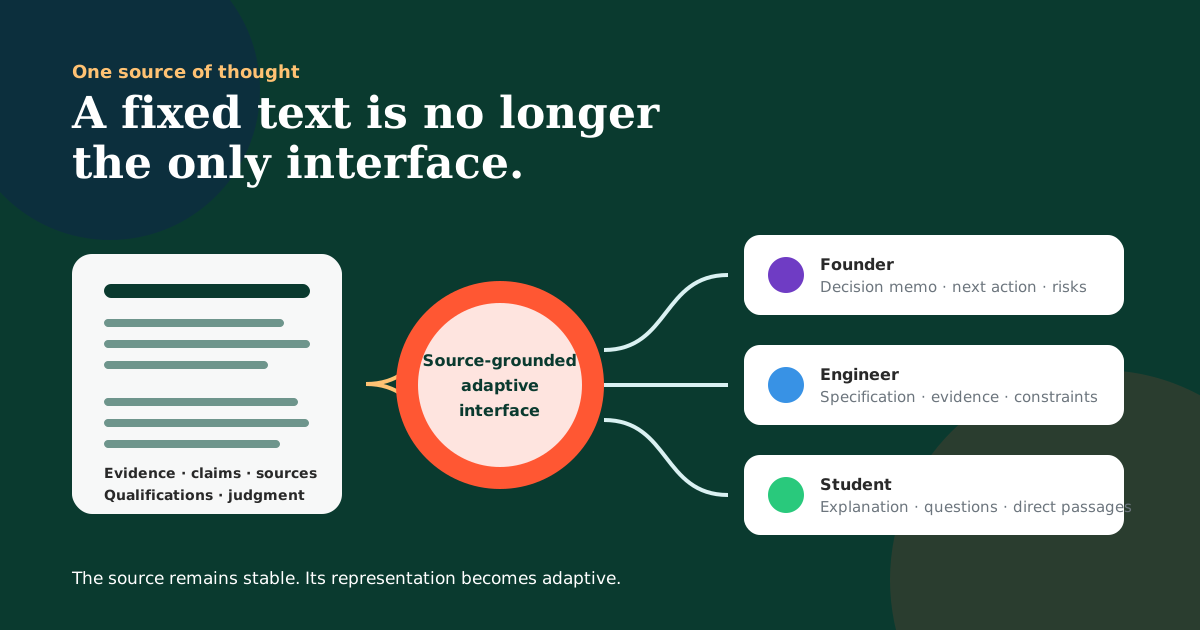
Those conditions change the selection, sequence, detail, application, and scrutiny of the material. The same underlying model can become a decision memo for a founder, a conceptual lesson for a student, a specification for an engineer, a checklist for an operator, a risk analysis for an investor, or an analogy for a general audience.
The source remains stable. Its representation becomes adaptive.
Interrogation replaces passive consumption
A summary is still a miniature book: one fixed sequence for an imaginary average reader. Compression alone does not create understanding. It can just remove the examples, qualifications, and repetition through which tacit judgment was carried.
The more important change is interrogation. A source-grounded system can be asked:
- Which parts apply to my situation?
- What did your compression omit?
- Where is the evidence weakest?
- What would the author probably dispute in my plan?
- How does this model differ from a competing one?
- Show the exact passage supporting this claim.
- Turn the principle into a test I can run this week.
- What would make the advice fail?
- Reinterpret it after seeing my results.
- What must I read directly before trusting this conclusion?
This is not permission to accept a chatbot’s answer. It is a method for directing attention, exposing uncertainty, and escalating to ground truth. The new knowledge object is not a summary. It is a source-grounded, interrogable model.
The old reading process was:
Read everything → hope to recognize what matters → remember fragments → attempt application later
The emerging process is:
State the question → construct a source-grounded representation → interrogate it → apply it → inspect the original wherever greater fidelity is required
The corresponding writing process changes from:
Think → manually draft → manually revise → publish one version
to:
Observe → assemble evidence → articulate intent → generate and interrogate representations → exercise judgment → approve and publish
Reading and writing do not disappear in these processes. They become escalation mechanisms. The machine handles more of the routine serialization and deserialization. The human goes directly to the sentences when their exact form matters.
One source, many legitimate representations
The natural final product may no longer be one document.
An author can maintain a canonical body of thought: evidence, claims, examples, sources, qualifications, counterarguments, values, and final judgments. An AI interface can render it differently for each legitimate use without pretending those renderings are the canonical source.
The static article or book still matters as a stable public record, a citable reference, a legally and intellectually accountable statement, and an authored aesthetic object. It is also the checksum against which adaptations can be tested. But it may no longer be the primary surface through which most people encounter the ideas.
This model changes the economics of authorship. Attribution, access rights, and compensation cannot become optional merely because the interface is adaptive. If the original thinker disappears from view, the system has not improved knowledge transfer. It has built a laundering layer between the source and the beneficiary.
The objections are not side issues
The strongest objection is devastatingly simple: if the writer did not think and the reader did not read, perhaps no communication occurred at all. AI can create an illusion of thought on one side and an illusion of understanding on the other. Unlimited generated prose then circulates between machines while no person finds it worth producing or consuming.
That will happen. It is already easy to approve language one could not defend. The solution is not to count human keystrokes. It is to demand evidence of cognition and responsibility: the author can explain the claim, reveal its sources, defend its choices, and own its errors; the recipient can question the model, apply it, identify its limits, and inspect the source.
Personalization can also become an intellectual padded room. A system optimized only for relevance will omit the difficult detour, alien premise, or slow accumulation that would have changed the reader. It can flatter existing beliefs and build a filter bubble more intimate than any social feed. Good personalization must sometimes preserve productive difficulty. It should surface competing interpretations, disclose omissions, and ask what the reader may be avoiding—not merely what they prefer.
Nor can every example be compressed into a rule. Repetition teaches weight. Stories carry tacit judgment. The architecture of an extended argument can be evidence. When those features matter, the honest interface should say so and direct the person to read the work itself.
We may lose concentration and writing skill if we never practice either. We may also drown in a bland average voice as generated language converges on what is probable. These objections succeed wherever the activity—not only its output—is the point. Someone who wants to learn sustained reasoning must sustain attention. Someone who wants a voice must make linguistic choices. Future thinkers still need to create original arguments and language rather than endlessly remix inherited text.
Finally, the mediator can hallucinate, omit, misquote, or attach a citation that does not support the sentence beside it. NIST’s generative AI risk profile treats confidently false content as a core risk, especially in consequential decisions. “Source-grounded” must therefore describe an inspectable system behavior, not a marketing adjective. Claims need passage-level support. Inference must be labeled. Uncertainty must survive rendering. High-stakes uses require independent verification.
AI mediation is not automatically originality on the author’s side or understanding on the reader’s. It is only an opportunity to remove unnecessary serialization between them.
What is actually ending
Original reading remains irreplaceable when language itself is the work, when someone wants literature rather than extracted conclusions, when an extended structure matters, when the source is foundational or contested, when subtle qualifications carry the argument, or when the AI cannot be trusted. It remains essential for studying great writers, training sustained attention, forming an independent interpretation, and experiencing a journey whose value cannot be separated from its sequence.
Original writing remains irreplaceable when wording creates the thought, reveals contradiction, carries consequence, or constitutes the art.
So the title is extreme only if “reading” and “writing” are defined as all contact with language and thought. That is not the age ending.
The age ending is the one in which a writer must manually serialize a mental model into one fixed text, then every reader must reconstruct that model by consuming the same text in the same order. It is the age in which manually writing and linearly reading every sentence are treated as the universal, intellectually superior default for transferring ideas.
Books, literacy, authorship, and serious thought survive. The original thinker and original source become more important, not less, because adaptive representations need something real to represent and something stable against which to be checked.
AI becomes the interface between that source and each recipient—not the source, not the judge, and not the party responsible for what follows.
What matters is not whether every sentence was manually written or personally read. What matters is whether a real thought was formed, faithfully transferred, critically examined, and responsibly acted upon.