Traditional marketing philosophy is designed primarily to capture or convert demand inside existing product categories. That is insufficient for foundational products such as replicators, terraforming systems, advanced materials, robotics, and new energy infrastructure.
These products have a harder communication problem. They must attach an enormous vision to an unavoidable present constraint, enter through a narrow and valuable wedge, make extraordinary capabilities physically observable, and show how each proof compounds toward a much larger future.
My previous formulation—Demand, Compression, and Demonstration—remains useful for conventional B2B products. Find an existing demand, compress the offer into a clear result, and demonstrate that result. But the model is incomplete for civilization-scale technology. It describes how to earn a customer without fully explaining how to create a category or assemble the coalition required to build it. That missing function is Trajectory.
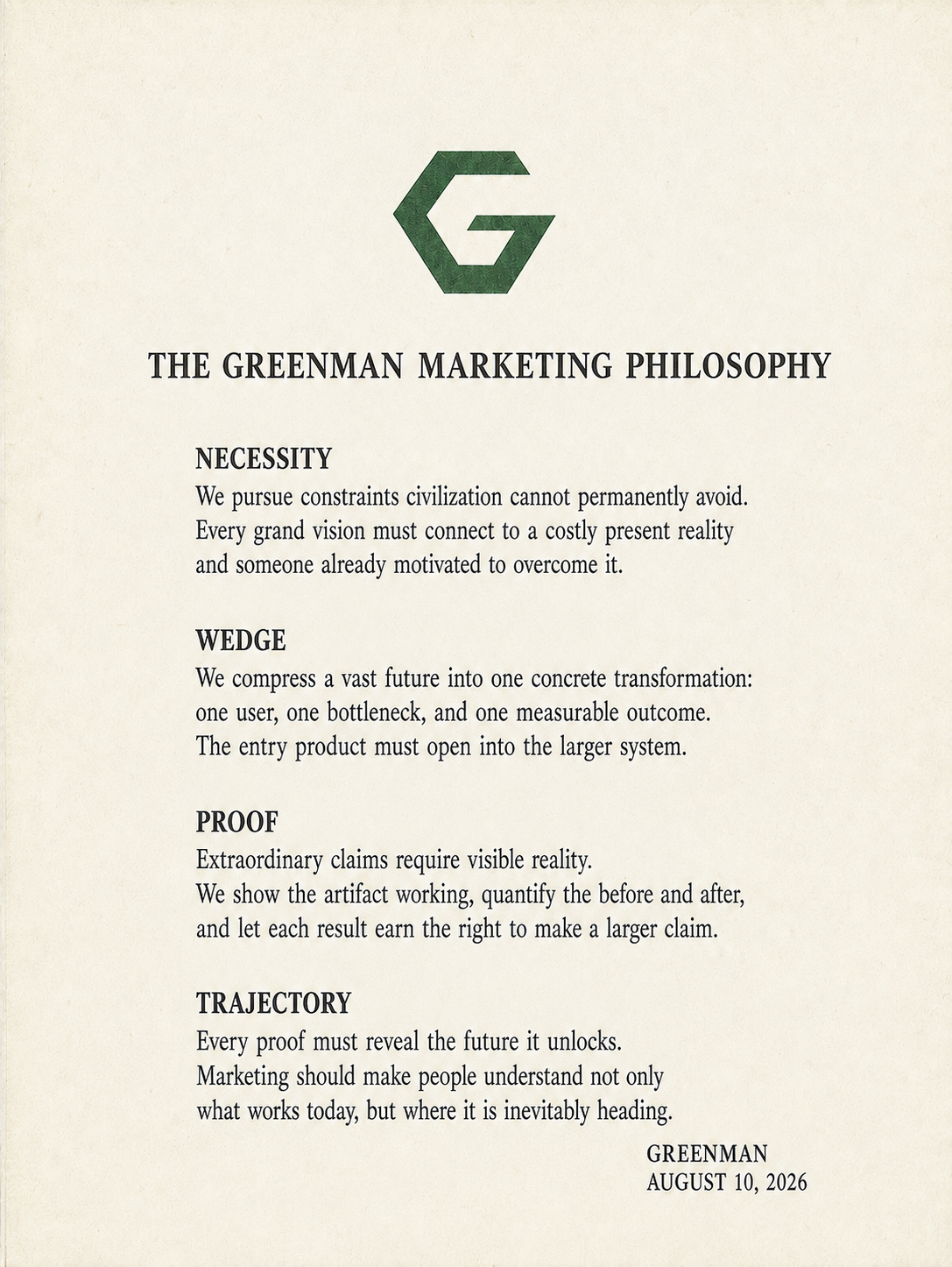
The complete system is Necessity, Wedge, Proof, and Trajectory.
Necessity
We pursue constraints civilization cannot permanently avoid. Every grand vision must connect to a costly present reality and someone already motivated to overcome it.
Expressed demand is useful, but it is downstream of what people currently believe is possible. A customer can request a faster industrial process. They are less likely to request a new material platform that changes which processes can exist.
Necessity looks beneath the request. It identifies a physical or civilizational constraint that will continue imposing costs until someone resolves it: scarce energy, fragile supply chains, limited material availability, uninhabitable environments, or labor that is dangerous and difficult to scale.
That does not excuse a company from finding a market now. Necessity determines the long-term direction; present commitment verifies the initial market. Someone must already spend time, money, political capital, or operational effort against the constraint. Otherwise the vision may describe a real future problem without identifying a viable place to begin.
Wedge
We compress a vast future into one concrete transformation: one user, one bottleneck, and one measurable outcome. The entry product must open into the larger system.
Compression should not flatten the vision into a generic efficiency claim. It should give the vision a clear entry point.
The wedge must be valuable on its own. A particular user should experience a specific before and after without needing to believe the entire roadmap. But the work required to deliver that result should also accumulate something the larger system needs: technical capabilities, manufacturing infrastructure, operational knowledge, proprietary data, regulatory standing, supplier relationships, or trust with demanding users.
A narrow product that leads nowhere is merely a niche. A broad platform with no narrow product is merely a story. The right wedge does both jobs: it solves an immediate problem and builds the next layer of the system.
Proof
Extraordinary claims require visible reality. We show the artifact working, quantify the before and after, and let each result earn the right to make a larger claim.
Frontier products cannot rely primarily on promises, branding, credentials, or speculative explanations. The more a capability contradicts ordinary experience, the more concrete the evidence must become.
Show the material surviving the test. Show the robot performing the task. Show the energy system operating under real load. State the baseline, the conditions, the result, and the remaining limitation.
Each claim must remain proportional to demonstrated evidence. A controlled prototype proves a controlled prototype, not universal reliability. A successful field deployment supports a larger claim, but only within the conditions actually tested. This restraint does not weaken the vision. It makes the evidence legible and gives the next claim somewhere solid to stand.
Trajectory
Every proof must reveal the future it unlocks. Marketing should make people understand not only what works today, but where it is inevitably heading.
The audience for a foundational product is larger than its customers. The company must also recruit scientists, engineers, investors, governments, suppliers, partners, and early believers. Each group needs to see both a credible present artifact and the role it could play in what comes next.
Trajectory is not a distant promise attached to a demonstration. It is the causal path exposed by the demonstration. If this capability now works at this scale, what becomes possible at the next scale? Which cost falls, which dependency disappears, which new environment opens, and which participant can now join?
A successful proof should make the next stage of the system legible. People should be able to understand why today’s bounded result changes the probability of tomorrow’s infrastructure.
Replicator
Do not begin by marketing “a machine that can make anything.” The claim is too broad to evaluate and too distant to organize action around.
Select one particular object or material, one available feedstock, one user or operating environment, and one measurable improvement in cost, time, logistics, or availability. The choice should follow evidence about necessity and present commitment; it should not be invented to make the story sound complete.
Then demonstrate the bounded transformation. If the system produces the chosen output reliably under stated conditions, the proof can establish a trajectory toward a wider material set, more variable feedstocks, less controlled environments, and progressively more general local production.
The framework does not dictate the definitive first market. It makes the decision criteria explicit: immediate value, observable performance, and capability accumulation toward the larger system.
Terraforming
Do not begin by marketing “terraforming a planet.” A destination at planetary scale offers no credible unit of progress.
Begin with one bounded environmental variable—soil, water, atmosphere, temperature, or a closed-loop habitat—and one present user who needs it changed. Define the starting condition, intervene, and measure the transformation over a meaningful period.
One proof may improve damaged soil for agriculture. Another may recover water in an isolated operating environment. The point is not to pretend either result is planetary engineering. It is to show how control over one variable, under increasingly difficult conditions, creates the knowledge and infrastructure required to control the next.
The unreachable destination becomes a sequence of increasingly ambitious proofs. Each stage is useful in the present and clarifies what must be true for the following stage to work.
Marketing as system design
Marketing for foundational products is not decoration added after invention. It is the discipline of making the path from present necessity to future infrastructure understandable, credible, and joinable.
The vision matters because it coordinates people around a future that does not yet exist. The wedge matters because coordination without present value cannot sustain itself. Proof matters because ambition must answer to reality. Trajectory matters because an isolated result does not explain the system it can become.
Find the necessity. Enter through the wedge. Prove the capability. Reveal the trajectory.