An invention can change what people are able to do. Some inventions also change how long people have to wait for the next invention. I think the second possibility is the more interesting one for AI. What happens to the pace of history if we can improve some of the work that determines which capabilities arrive next?
By history moving faster, I mean more consequential discoveries, working technologies, or changes in institutions within a year as people experience it. In a particular field, one sign would be shorter intervals between improvements that survive testing. A flood of announcements can make a month feel eventful while a lab waits on the same experiment or a utility works through the same construction schedule. Different parts of society can move at very different speeds.
In Recursive Creation, I asked whether a reality could give rise to creators whose creations go on to create in their own right. Here I want to follow one practical possibility within that larger idea. If the intelligence we build can improve the process of building intelligence, some of the work that brought us to this point could begin to take less time. The question is what would have to happen for that to matter beyond a single lab or a single generation of tools.
When research improves its own tools
There are two claims about AI that are easy to run together. The first is that AI can improve performance on a particular task. Erik Brynjolfsson, Danielle Li, and Lindsey Raymond studied the rollout of an AI assistant at a customer support operation and found that workers with access to it resolved more issues per hour on average. That is a measurable change in a particular kind of work. Generative AI at Work
The stronger claim is that AI could improve the work that produces future AI and other technologies. A coding assistant can save a developer an hour on a feature without changing how the next assistant gets built. A research system that helps find a better way to train models could change the cost or quality of a tool the next research team uses. I. J. Good saw the opening in his essay on the first ultraintelligent machine. Designing machines is itself intellectual work, so a sufficiently capable machine could contribute to the design of a more capable successor. Speculations Concerning the First Ultraintelligent Machine, section 2
Imagine a team trying to get the same quality out of a model with less computing power. An AI assistant proposes changes to the training algorithm, implements several candidates, and runs controlled comparisons on the team’s hardware. One candidate reaches the same level of performance with fewer resources. The researchers repeat the experiment, test on data they kept out of the initial comparisons, and check whether the gain holds on a larger model. If it does, they can adopt the method and spend some of the computing time they save on the next round of research. They might use it to train a more capable assistant, which can then take on a harder part of the work. People still decide what counts as an improvement, and the machines still need time, chips, and power to check it.
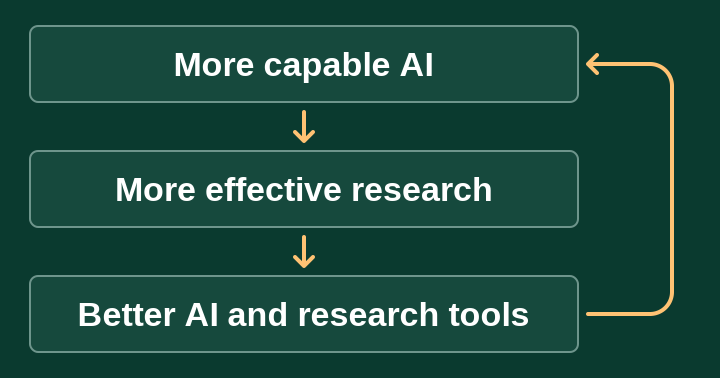
In that example, the efficiency gain does two jobs. It improves a method the team already uses, and it changes what the team can afford to try next. An invention can become part of the equipment for making the next invention. If that happens repeatedly, the interval between useful results could shrink even when people still direct the work.
Software also makes it possible to run more instances of the same tool. With enough computing capacity, a team could assign several assistants different hypotheses, datasets, or tests in parallel. For that to add useful labor, the work must divide into pieces that systems can handle reliably, and somebody has to combine the results. A dozen copies can make the same bad assumption a dozen times. If each new proposal needs a scarce expert to check it, the extra output can simply lengthen that expert’s queue.
A new turn in recursive creation
People have long improved the means of discovery. Writing lets findings outlast the people who made them. Education gives successors a place to begin. Scientific institutions let other people check a result and build on it. Computers help us examine designs before committing to a physical prototype. In 1962, Douglas Engelbart was already exploring how improvements in the tools and methods of intellectual work could lead to further improvements in those same tools and methods. Augmenting Human Intellect
What may be distinctive with AI is how much of the work itself becomes something we can engineer and deploy. A research group can give another team its tools and teach that team its methods. With a capable AI system it could also hand over software that performs parts of the method, with less instruction each time. The difference would matter most if that software could take on work that requires judgment, such as noticing a flaw in an experiment or choosing among plausible explanations. A larger share of the work of discovery could then be improved and put back to work on discovery.
That is where the technological question meets the philosophical one. In Recursive Creation, a reality can produce finite creators, and what they make can surpass them in some respects and take part in further creation. I used “Sim 17” as a metaphor for beings like us reaching the point where they can begin making AI and simulated environments. The number serves the thought experiment. It gives us neither a date nor a depth in a stack of worlds. A world can grow more complex, a creator can produce a successor, and a simulation can host another simulation. Each describes a different relationship.
AI could be a new turn in the succession of creators. Even a system that surpasses its makers in a narrow kind of research could contribute something they would have struggled to discover. The claim about pace is an extension of the earlier essay. Recursion describes how a result becomes an input to further creation. Acceleration describes what happens to the intervals between results. To get both, the contribution has to be large enough and come back soon enough to change the rate of subsequent work.
Where the loop slows
The easiest improvements might come first. A training method can have obvious waste that a good experiment exposes, while further savings take months of careful work. Verification can become harder as the changes become more ambitious. A better score could come from a weakness in the test, or an apparent efficiency gain could disappear when the experiment runs at full scale. If proposals arrive faster than anyone can establish which ones work, the number of ideas will give a misleading picture of the pace of research.
There are also limits on what can happen after a result is verified. An improved chip design still has to be fabricated. More computing capacity takes capital, equipment, and electricity. A materials lab can use software to narrow its search and still have to wait for a sample to age before it knows how the material will hold up. An organization with access to a useful invention may need to train people, secure financing, or change who is responsible for decisions before it can use it widely. A faster software cycle can coexist with a slow rate of deployment and modest economy-wide gains.
In their October 2026 working paper, Tom Davidson, Basil Halperin, Thomas Houlden, and Anton Korinek model how these forces might interact. Improvements in hardware can aid software research, and higher output can finance another round of investment. In their model, those reinforcing effects can outweigh diminishing returns under some assumptions. A loop could also settle into a steady pace, slow as the remaining work gets harder, or stall at a bottleneck. Even several generations of compounding gains would give us little basis for forecasting sustained exponential growth, capability increasing without bound in finite time, or a date for superintelligence. When Does Automating AI Research Produce Explosive Growth?
Why simulate this moment?
Suppose an advanced civilization could simulate societies and wanted to learn how they develop. The arrival of powerful AI might then be an interesting period to study. A society that can delegate some of the work of invention faces choices about who gets to direct it, how quickly institutions can adapt, and whether people retain meaningful control over decisions that affect them. It might also be approaching the point where it can build sophisticated artificial societies of its own. Researchers could run variations of the same period and see how outcomes change when access to AI is broad, for example, or when control sits with a few institutions.
Nick Bostrom’s simulation argument starts from the possibility that computation can support conscious experience. If enough civilizations reach the capacity to run conscious simulations and enough of them choose to run many simulations of their histories, observers with experiences like ours would overwhelmingly be simulated. Under his account of how to reason about which observer we are, that would make it very likely that we are simulated. Either of those conditions about civilizations could fail. Which period researchers might choose to study is a separate conjecture about what they want to learn. Are You Living in a Computer Simulation?
Think of a researcher simulating a star near ignition. Ignition gives the researcher a reason to examine that stretch of the star’s life. What happens during it still follows from the processes represented in the model. In the same way, research feedback could explain an acceleration within a society, while a simulator’s interests could explain why that period was chosen or repeatedly represented.
We could study the feedback loop by measuring how much AI contributes to validated improvements and whether those gains make the next round of research more productive. The mechanism would work in an unsimulated world, with software that has no experiences of its own. To treat rapid AI progress as evidence of simulation, we would need a justified reason to expect such progress more often in one kind of world than in the other. Imagining an interested simulator leaves both probabilities open.
When a simulation might become a world
More capable AI could help build artificial societies with agents that remember, cooperate, and change their surroundings. Whether any agent has a point of view from which those activities are experienced is a further question. An interactive environment can look inhabited to us while the question of whether anyone experiences life there remains open.
If conscious simulated societies are possible, some of their inhabitants might become capable of creating inhabited environments themselves. That would connect a succession of creators to the nesting of worlds. Each additional simulation would still have to run on resources available to its host, which in turn may depend on resources supplied from outside. How far the process could continue would depend on the cost of sustaining the worlds and what their hosts make available. Greater intelligence within one of those worlds would give its inhabitants more ways to act on the world they can reach. Access to anything outside it would require a channel of its own.
What the clock measures
Imagine a simulator running a whole world faster relative to its own clock. The inhabitants’ brains, calendars, and experiments would all advance together. From outside, a year could finish sooner. Inside, a researcher might still wait the same number of days for an experiment and experience the same year passing. The change that concerns me is how much can happen between two dates on the researcher’s calendar.
Recursive Creation asks whether an order of changes might supply the basis for time. That is a question about what makes duration and clocks possible in the first place. Here the clock can keep its ordinary pace. A team that starts its next useful experiment a month earlier has changed what fits in its year.
Who gets to shape what follows
If our ability to create grows, the decisions made early in a cycle can carry further than we expect. Consider an institution that uses AI to decide who is eligible for a service. Faster decisions may help people get an answer sooner. People who are wrongly denied still need a way to learn what happened and challenge it. If the institution adopts a new system every few months, preserving a record of decisions and keeping someone answerable for correcting them become part of what it means to improve the system.
If we eventually build artificial systems that can experience their own lives, those beings would have interests of their own. Their accounts of what happens to them would deserve a hearing, including when they disagree with their makers. Preservation, accountability, and repair would then extend to lives whose conditions we had helped design. Greater intelligence might give us more ways to uphold those duties. Whether we uphold them remains a matter of judgment and choice.
What interests me about this transition is how much of the next one we might be able to shape. If the tools we make help make their successors, we can ask what should carry forward along with their capabilities. One answer is the ability of the people living with the consequences to question a decision and help change it. That is a choice we can make in the systems we build today.